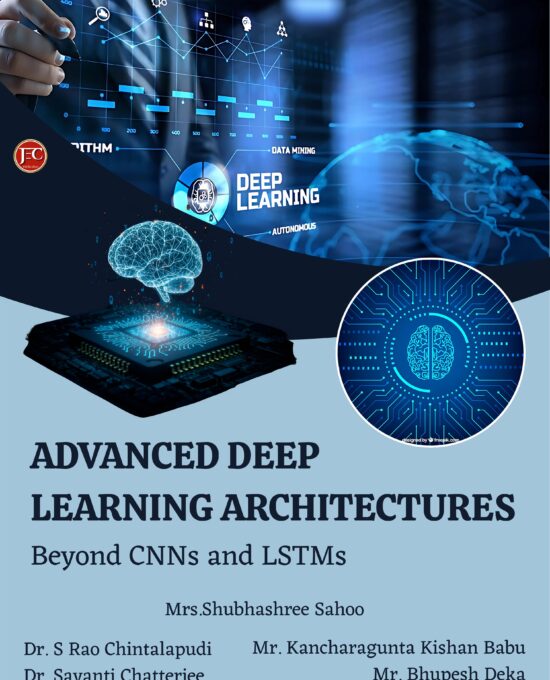
ADVANCED DEEP LEARNING ARCHITECTURES Beyond CNNs and LSTMs
₹499.00
Deep learning has fundamentally transformed the landscape of artificial intelligence, powering
breakthroughs in computer vision, natural language processing, speech recognition, and beyond.
Over the past decade, Convolutional Neural Networks (CNNs) and Long Short-Term Memory
networks (LSTMs) emerged as the dominant architectures for tackling structured image data and
sequential information, respectively. CNNs, with their hierarchical feature extraction and local
receptive fields, revolutionized image classification, object detection, and semantic segmentation,
enabling systems to achieve near-human or even superhuman performance on benchmarks such
as ImageNet. LSTMs, on the other hand, overcame the limitations of traditional recurrent neural
networks, effectively addressing the vanishing gradient problem and enabling long-range
temporal dependencies to be learned, thereby advancing language modeling, machine translation,
and speech synthesis.
However, as datasets expanded to billions of samples, tasks grew increasingly complex, and the
need for generalization across heterogeneous domains intensified, the inherent limitations of
CNNs and LSTMs became apparent. CNNs struggle with modeling long-range dependencies,
processing irregular graph-structured data, or integrating multimodal inputs, while LSTMs face
challenges in parallelization, handling very long sequences efficiently, and scaling to massive
model sizes. Moreover, simply increasing depth, width, or training data does not always guarantee
proportional improvements in performance, highlighting the plateauing effect of these
architectures in cutting-edge AI applications.
This book, Advanced Deep Learning Architectures: Beyond CNNs and LSTMs, is designed to chart
the evolution of next-generation architectures that address these limitations and define the future
of artificial intelligence. It offers a comprehensive journey through the design principles,
mathematical foundations, and practical implementations of state-of-the-art models. The scope
spans transformers — including BERT, GPT, and Vision Transformers — which leverage selfattention to model long-range dependencies and multimodal relationships; graph neural networks,
which enable AI systems to reason about relational and non-Euclidean data; capsule networks,
which improve spatial hierarchies and pose awareness; neural ordinary differential equations,
which introduce continuous-time modeling; and diffusion models, which have redefined
generative AI through probabilistic modeling and denoising frameworks. The book also delves
into hybrid and multimodal architectures, advanced reinforcement learning frameworks, and
emerging paradigms such as neuromorphic computing, quantum deep learning, and evolutionary algorithms. Importantly, the text bridges theory and practice. Each chapter combines rigorous
mathematical derivations — from linear algebra and tensor calculus to probabilistic modeling and
information-theoretic analysis — with hands-on Python implementations using libraries such as
PyTorch, TensorFlow, and NumPy. Readers are guided through step-by-step coding exercises,
practical tips for optimization, and demonstrations of applying these models to real-world datasets.
This dual approach ensures a deep understanding not just of why these architectures work, but
how to implement, experiment, and extend them.
Beyond technical mastery, the book emphasizes the broader implications of advanced AI:
multimodal intelligence, ethical alignment, interpretability, and the path toward general-purpose
AI systems.
ADVANCED DEEP LEARNING ARCHITECTURES Beyond CNNs and LSTMs
₹499.00
Deep learning has fundamentally transformed the landscape of artificial intelligence, powering
breakthroughs in computer vision, natural language processing, speech recognition, and beyond.
Over the past decade, Convolutional Neural Networks (CNNs) and Long Short-Term Memory
networks (LSTMs) emerged as the dominant architectures for tackling structured image data and
sequential information, respectively. CNNs, with their hierarchical feature extraction and local
receptive fields, revolutionized image classification, object detection, and semantic segmentation,
enabling systems to achieve near-human or even superhuman performance on benchmarks such
as ImageNet. LSTMs, on the other hand, overcame the limitations of traditional recurrent neural
networks, effectively addressing the vanishing gradient problem and enabling long-range
temporal dependencies to be learned, thereby advancing language modeling, machine translation,
and speech synthesis.
However, as datasets expanded to billions of samples, tasks grew increasingly complex, and the
need for generalization across heterogeneous domains intensified, the inherent limitations of
CNNs and LSTMs became apparent. CNNs struggle with modeling long-range dependencies,
processing irregular graph-structured data, or integrating multimodal inputs, while LSTMs face
challenges in parallelization, handling very long sequences efficiently, and scaling to massive
model sizes. Moreover, simply increasing depth, width, or training data does not always guarantee
proportional improvements in performance, highlighting the plateauing effect of these
architectures in cutting-edge AI applications.
This book, Advanced Deep Learning Architectures: Beyond CNNs and LSTMs, is designed to chart
the evolution of next-generation architectures that address these limitations and define the future
of artificial intelligence. It offers a comprehensive journey through the design principles,
mathematical foundations, and practical implementations of state-of-the-art models. The scope
spans transformers — including BERT, GPT, and Vision Transformers — which leverage selfattention to model long-range dependencies and multimodal relationships; graph neural networks,
which enable AI systems to reason about relational and non-Euclidean data; capsule networks,
which improve spatial hierarchies and pose awareness; neural ordinary differential equations,
which introduce continuous-time modeling; and diffusion models, which have redefined
generative AI through probabilistic modeling and denoising frameworks. The book also delves
into hybrid and multimodal architectures, advanced reinforcement learning frameworks, and
emerging paradigms such as neuromorphic computing, quantum deep learning, and evolutionary algorithms. Importantly, the text bridges theory and practice. Each chapter combines rigorous
mathematical derivations — from linear algebra and tensor calculus to probabilistic modeling and
information-theoretic analysis — with hands-on Python implementations using libraries such as
PyTorch, TensorFlow, and NumPy. Readers are guided through step-by-step coding exercises,
practical tips for optimization, and demonstrations of applying these models to real-world datasets.
This dual approach ensures a deep understanding not just of why these architectures work, but
how to implement, experiment, and extend them.
Beyond technical mastery, the book emphasizes the broader implications of advanced AI:
multimodal intelligence, ethical alignment, interpretability, and the path toward general-purpose
AI systems.













ANATOMY OF PLANTS
₹499.00
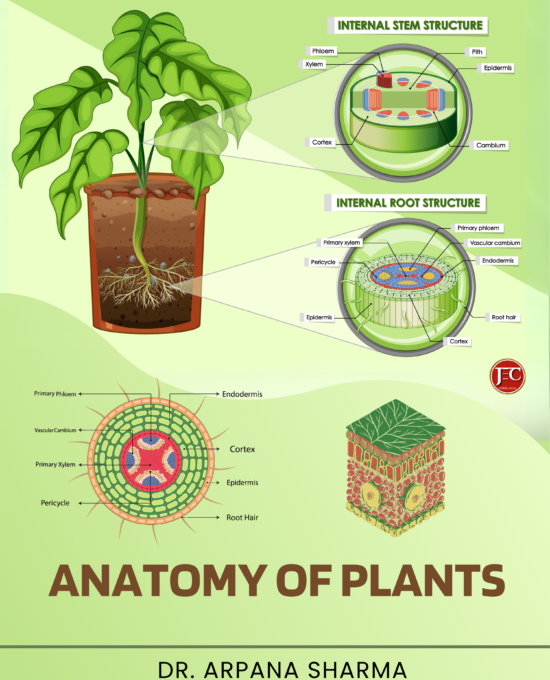
The study of plant anatomy is not only central to understanding the structural organization of plants but also to appreciating the intricate processes that govern their growth, reproduction, and survival. Plants, as primary producers, form the foundation of life on Earth, and their internal structure provides valuable insights into their adaptability, ecological roles, and evolutionary success. This book, Anatomy of Plants, is designed to serve as a comprehensive guide for students, educators, and researchers who wish to delve into the fundamental aspects of plant structure and function.
The chapters in this volume have been carefully arranged to provide a logical progression from the basics of wood anatomy and growth rings to the complex processes of gametophyte development, pollination, fertilization, and embryogenesis. Each concept has been explained with clarity, supported by comparative tables, diagrams, and self-assessment questions to aid both understanding and retention. In addition to the classical foundations of plant anatomy, the book incorporates applied aspects such as dendrochronology, reproductive adaptations, and mechanisms like apomixis and parthenocarpy, which are of significance in both ecological studies and agricultural practices.
This book has been written with undergraduate and postgraduate learners in mind, but it will also be useful for aspirants of competitive examinations and researchers seeking a consolidated resource. By combining theoretical detail with practical assessment exercises, it bridges the gap between academic knowledge and applied learning. I sincerely hope that readers will find this work informative, engaging, and enriching in their exploration of the fascinating world of plant anatomy.
ANATOMY OF PLANTS
₹499.00
The study of plant anatomy is not only central to understanding the structural organization of plants but also to appreciating the intricate processes that govern their growth, reproduction, and survival. Plants, as primary producers, form the foundation of life on Earth, and their internal structure provides valuable insights into their adaptability, ecological roles, and evolutionary success. This book, Anatomy of Plants, is designed to serve as a comprehensive guide for students, educators, and researchers who wish to delve into the fundamental aspects of plant structure and function.
The chapters in this volume have been carefully arranged to provide a logical progression from the basics of wood anatomy and growth rings to the complex processes of gametophyte development, pollination, fertilization, and embryogenesis. Each concept has been explained with clarity, supported by comparative tables, diagrams, and self-assessment questions to aid both understanding and retention. In addition to the classical foundations of plant anatomy, the book incorporates applied aspects such as dendrochronology, reproductive adaptations, and mechanisms like apomixis and parthenocarpy, which are of significance in both ecological studies and agricultural practices.
This book has been written with undergraduate and postgraduate learners in mind, but it will also be useful for aspirants of competitive examinations and researchers seeking a consolidated resource. By combining theoretical detail with practical assessment exercises, it bridges the gap between academic knowledge and applied learning. I sincerely hope that readers will find this work informative, engaging, and enriching in their exploration of the fascinating world of plant anatomy.