

A Journey Through Computational Biology
₹499.00
A Journey Through Computational Biology was born out of a realization that while many excellent
texts exist on either biology or computer science, a truly integrated approach—one that speaks to
both beginners and those with moderate knowledge—is exceedingly rare.
The aim of this book is to demystify how algorithms extract meaning from the chaotic, vast realms
of biological data. To do this, we structured the book progressively. Readers will begin with
foundations, traverse sequence and structural biology, explore cutting-edge omics, and finally
understand how machine learning and cloud infrastructures are redefining what it means to study
life. Every chapter is designed not only to teach theoretical concepts but also to provide pragmatic,
hands-on activities.
Welcome to the intersection of code and life.
A Journey Through Computational Biology
₹499.00
A Journey Through Computational Biology was born out of a realization that while many excellent
texts exist on either biology or computer science, a truly integrated approach—one that speaks to
both beginners and those with moderate knowledge—is exceedingly rare.
The aim of this book is to demystify how algorithms extract meaning from the chaotic, vast realms
of biological data. To do this, we structured the book progressively. Readers will begin with
foundations, traverse sequence and structural biology, explore cutting-edge omics, and finally
understand how machine learning and cloud infrastructures are redefining what it means to study
life. Every chapter is designed not only to teach theoretical concepts but also to provide pragmatic,
hands-on activities.
Welcome to the intersection of code and life.

A Practical Book Of Pharmaceutics-I
Published on 2025
₹499.00
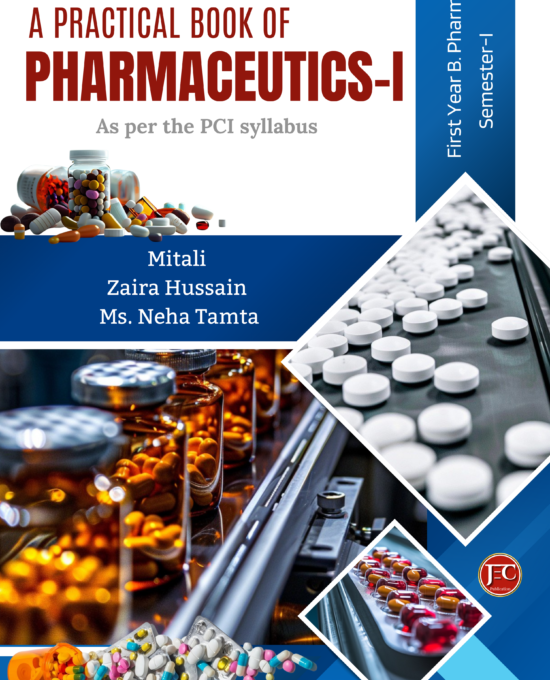
It gives me immense pleasure to present to pharmacy students my book entitled "A Practical Book
of Pharmaceutics-I". Writing a book is inspiring, often exciting, and sometimes very challenging
work.
Pharmaceutics practical involve the practical application of scientific principles to the formulation
and development of pharmaceutical products. These practical sessions typically include various
aspects such as drug formulation, dosage form design, and manufacturing techniques. Students learn
to handle equipment, perform experiments, and gain hands-on experience in pharmaceutical
processes. Key components may include compounding, granulation, tablet pressing, and quality
control methods. Proficiency in basic techniques like accurate measurements, proper handling of
equipment, and adherence to good laboratory practices is fundamental, laying the groundwork for
more advanced studies in pharmaceutics. Without a strong foundation in these practical skills,
progressing to advanced pharmaceutical development becomes challenging and resource-intensive.
The book contains calculations and important questions related to the experiments to fulfill the
requirements of students.
I record my sincere thanks to Dr. Navneet Verma, Dr. Arun Kumar Mishra, Dr. Sushil Kumar, Dr.
Munish Mani, Dr. Shweta Verma, and all my coauthors for constant encouragement to write this
book.
I thank my parents for their constant support to review the content of this book and moral support. I
am thankful to my seniors, friends and students who gave me suggestions whenever I asked for
betterment of this book.
I appreciate the cooperation and interest taken by Publishers JEC Publication in bringing out this
book.
I will be grateful to all the teachers and students who will be kind enough to point out my mistakes
that have escaped my attention. Suggestions for future improvement are always welcome.
A Practical Book Of Pharmaceutics-I
₹499.00
It gives me immense pleasure to present to pharmacy students my book entitled "A Practical Book
of Pharmaceutics-I". Writing a book is inspiring, often exciting, and sometimes very challenging
work.
Pharmaceutics practical involve the practical application of scientific principles to the formulation
and development of pharmaceutical products. These practical sessions typically include various
aspects such as drug formulation, dosage form design, and manufacturing techniques. Students learn
to handle equipment, perform experiments, and gain hands-on experience in pharmaceutical
processes. Key components may include compounding, granulation, tablet pressing, and quality
control methods. Proficiency in basic techniques like accurate measurements, proper handling of
equipment, and adherence to good laboratory practices is fundamental, laying the groundwork for
more advanced studies in pharmaceutics. Without a strong foundation in these practical skills,
progressing to advanced pharmaceutical development becomes challenging and resource-intensive.
The book contains calculations and important questions related to the experiments to fulfill the
requirements of students.
I record my sincere thanks to Dr. Navneet Verma, Dr. Arun Kumar Mishra, Dr. Sushil Kumar, Dr.
Munish Mani, Dr. Shweta Verma, and all my coauthors for constant encouragement to write this
book.
I thank my parents for their constant support to review the content of this book and moral support. I
am thankful to my seniors, friends and students who gave me suggestions whenever I asked for
betterment of this book.
I appreciate the cooperation and interest taken by Publishers JEC Publication in bringing out this
book.
I will be grateful to all the teachers and students who will be kind enough to point out my mistakes
that have escaped my attention. Suggestions for future improvement are always welcome.
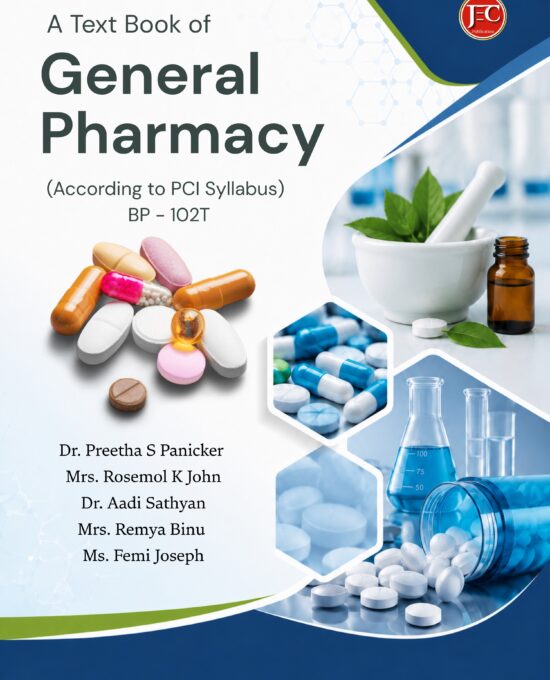
A Text Book of General Pharmacy
₹499.00
A Text Book of General Pharmacy is a comprehensive academic textbook developed in accordance with the Pharmacy Council of India (PCI) syllabus for BP-102T. Designed for Diploma in Pharmacy (D.Pharm) students, this book provides a strong foundation in the fundamental principles of pharmaceutical sciences through a clear, structured, and student-friendly approach. The book covers essential concepts of general pharmacy, including dosage forms, pharmaceutical calculations, prescription handling, routes of drug administration, pharmaceutical aids, incompatibilities, storage of medicines, and dispensing practices. Complex topics are explained in simple language with illustrations, tables, and practical examples to enhance understanding and classroom learning. Prepared by experienced academicians, this textbook serves as an ideal resource for regular coursework, laboratory sessions, internal assessments, and university examinations. It bridges theoretical knowledge with practical applications, helping students develop the essential skills required for a successful career in pharmacy.
A Text Book of General Pharmacy
₹499.00
A Text Book of General Pharmacy is a comprehensive academic textbook developed in accordance with the Pharmacy Council of India (PCI) syllabus for BP-102T. Designed for Diploma in Pharmacy (D.Pharm) students, this book provides a strong foundation in the fundamental principles of pharmaceutical sciences through a clear, structured, and student-friendly approach. The book covers essential concepts of general pharmacy, including dosage forms, pharmaceutical calculations, prescription handling, routes of drug administration, pharmaceutical aids, incompatibilities, storage of medicines, and dispensing practices. Complex topics are explained in simple language with illustrations, tables, and practical examples to enhance understanding and classroom learning. Prepared by experienced academicians, this textbook serves as an ideal resource for regular coursework, laboratory sessions, internal assessments, and university examinations. It bridges theoretical knowledge with practical applications, helping students develop the essential skills required for a successful career in pharmacy.

A Text Book Of Pharmaceutical Analysis
₹499.00
A Text Book of Pharmaceutical Analysis is a comprehensive academic textbook designed for Diploma, Undergraduate, and Pharmacy students studying Pharmaceutical Analysis as per the latest syllabus. The book provides a clear understanding of the fundamental principles, analytical techniques, instrumentation, and quality control methods used in pharmaceutical sciences. Written in a simple, student-friendly language, the text covers classical chemical analysis, instrumental analytical methods, validation of analytical procedures, calibration techniques, pharmaceutical standards, and laboratory practices. It emphasizes both theoretical concepts and practical applications, helping students build a strong foundation for academic examinations as well as professional pharmaceutical practice. The book includes well-structured chapters, illustrations, tables, flowcharts, solved examples, and review questions to enhance learning and retention. It is an ideal resource for students, educators, researchers, and pharmacy professionals seeking reliable knowledge in pharmaceutical analysis.
A Text Book Of Pharmaceutical Analysis
₹499.00
A Text Book of Pharmaceutical Analysis is a comprehensive academic textbook designed for Diploma, Undergraduate, and Pharmacy students studying Pharmaceutical Analysis as per the latest syllabus. The book provides a clear understanding of the fundamental principles, analytical techniques, instrumentation, and quality control methods used in pharmaceutical sciences. Written in a simple, student-friendly language, the text covers classical chemical analysis, instrumental analytical methods, validation of analytical procedures, calibration techniques, pharmaceutical standards, and laboratory practices. It emphasizes both theoretical concepts and practical applications, helping students build a strong foundation for academic examinations as well as professional pharmaceutical practice. The book includes well-structured chapters, illustrations, tables, flowcharts, solved examples, and review questions to enhance learning and retention. It is an ideal resource for students, educators, researchers, and pharmacy professionals seeking reliable knowledge in pharmaceutical analysis.


