A Textbook Of Pharmaceutical Engineering
₹499.00
Pharmaceutical Engineering is an important branch of pharmaceutical sciences that deals with the
application of engineering principles in the design, operation, and optimization of pharmaceutical
manufacturing processes. The subject provides a fundamental understanding of various unit operations such
as size reduction, mixing, filtration, drying, heat transfer, evaporation, distillation, and material handling. A
thorough knowledge of these concepts is essential for pharmacy students to understand the scientific and
technological aspects involved in the production of quality pharmaceutical products. This textbook has been
carefully prepared to meet the syllabus requirements of Diploma in Pharmacy, Bachelor of Pharmacy, and
other allied pharmaceutical courses. The content is presented in a simple, systematic, and student-friendly
manner to facilitate effective learning. Special emphasis has been given to explaining basic engineering
principles, pharmaceutical equipment, process operations, and their practical applications in the
pharmaceutical industry. Illustrations, diagrams, and examples have been included wherever necessary to
enhance the understanding of complex topics. The authors sincerely hope that this book will serve as a
valuable resource for students, teachers, and professionals in the field of pharmacy. Every effort has been
made to ensure the accuracy and relevance of the material presented. Suggestions and constructive feedback
from readers will be highly appreciated and will help in improving future editions of this book. We express
our gratitude to all colleagues, students, and the team at JEC Publication for their support and contribution
in bringing out this textbook.
A Textbook Of Pharmaceutical Engineering
₹499.00
Pharmaceutical Engineering is an important branch of pharmaceutical sciences that deals with the
application of engineering principles in the design, operation, and optimization of pharmaceutical
manufacturing processes. The subject provides a fundamental understanding of various unit operations such
as size reduction, mixing, filtration, drying, heat transfer, evaporation, distillation, and material handling. A
thorough knowledge of these concepts is essential for pharmacy students to understand the scientific and
technological aspects involved in the production of quality pharmaceutical products. This textbook has been
carefully prepared to meet the syllabus requirements of Diploma in Pharmacy, Bachelor of Pharmacy, and
other allied pharmaceutical courses. The content is presented in a simple, systematic, and student-friendly
manner to facilitate effective learning. Special emphasis has been given to explaining basic engineering
principles, pharmaceutical equipment, process operations, and their practical applications in the
pharmaceutical industry. Illustrations, diagrams, and examples have been included wherever necessary to
enhance the understanding of complex topics. The authors sincerely hope that this book will serve as a
valuable resource for students, teachers, and professionals in the field of pharmacy. Every effort has been
made to ensure the accuracy and relevance of the material presented. Suggestions and constructive feedback
from readers will be highly appreciated and will help in improving future editions of this book. We express
our gratitude to all colleagues, students, and the team at JEC Publication for their support and contribution
in bringing out this textbook.
A Textbook of Pharmaceutical Inorganic and Analytical Chemistry
₹499.00
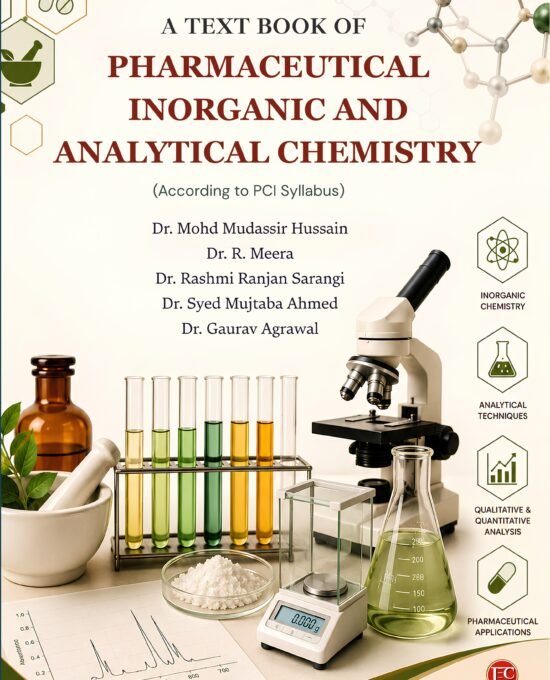
A Textbook of Pharmaceutical Inorganic and Analytical Chemistry is designed as a comprehensive and student-friendly resource for pharmacy students, particularly in accordance with the PCI syllabus and NEP-2020 framework.
The book covers fundamental concepts of pharmaceutical analysis, errors, standards, limit tests, acid–base chemistry, titrations, gastrointestinal agents, antimicrobials, radiopharmaceuticals, and miscellaneous pharmaceutical compounds. It also introduces important analytical techniques such as HPLC, GC, LC-MS, UV-Visible, IR, NMR, DSC, and titrimetric methods, with their principles and pharmaceutical applications.
The content has been presented in a clear and systematic manner to help students understand both theoretical concepts and their practical significance in pharmaceutical analysis. It is hoped that this book will serve as a useful reference for classroom learning, examinations, and developing a strong foundation in pharmaceutical inorganic and analytical chemistry.
A Textbook of Pharmaceutical Inorganic and Analytical Chemistry
₹499.00
A Textbook of Pharmaceutical Inorganic and Analytical Chemistry is designed as a comprehensive and student-friendly resource for pharmacy students, particularly in accordance with the PCI syllabus and NEP-2020 framework.
The book covers fundamental concepts of pharmaceutical analysis, errors, standards, limit tests, acid–base chemistry, titrations, gastrointestinal agents, antimicrobials, radiopharmaceuticals, and miscellaneous pharmaceutical compounds. It also introduces important analytical techniques such as HPLC, GC, LC-MS, UV-Visible, IR, NMR, DSC, and titrimetric methods, with their principles and pharmaceutical applications.
The content has been presented in a clear and systematic manner to help students understand both theoretical concepts and their practical significance in pharmaceutical analysis. It is hoped that this book will serve as a useful reference for classroom learning, examinations, and developing a strong foundation in pharmaceutical inorganic and analytical chemistry.
A textbook of Pharmaceutics-I
₹499.00
The discipline of pharmaceutics serves as a vital bridge between drug discovery and the large-scale
production of medications that adhere to regulatory, safety, and efficacy standards. As the pharmaceutical
sciences continue to advance, it is crucial for students to build a solid understanding of the principles,
processes, and practices that underpin the industrial manufacturing of pharmaceutical products.
This textbook on Pharmaceutics is specifically crafted for first-semester B. Pharm students. It offers a
thorough exploration of industrial pharmacy, covering key topics such as formulation development,
quality control, manufacturing processes, regulatory compliance, and the principles of Good
Manufacturing Practices (GMP). The book aims to provide students with both foundational theoretical
knowledge and practical insights essential for navigating the complexities of pharmaceutical production.
Each chapter has been meticulously organized to ensure clarity and comprehension, incorporating
detailed explanations, illustrative diagrams, and real-world examples to enhance the learning experience.
Special attention has been given to industry-relevant subjects to foster critical thinking and problemsolving skills, which are indispensable in today’s rapidly evolving pharmaceutical sector.
Additionally, the textbook addresses significant emerging trends in pharmaceutical manufacturing, such
as advancements in automation, biotechnology, and regulatory affairs. This forward-looking approach
prepares students to tackle future challenges in the field. By bridging academic concepts with practical
applications, the book aligns with the demands of the professional world, making it a valuable resource
for aspiring industrial pharmacy professionals.
It is my hope that this textbook will serve as an indispensable guide, equipping students with the
knowledge and skills necessary to excel in both their academic journey and their professional careers in
industrial pharmacy.
Mr. Mahesh P. Junghare
(M. Pharm. – Pharmacognosy)
Ms. Yamini C. Sonewane
(Bachelor of Pharmacy)
A textbook of Pharmaceutics-I
₹499.00
The discipline of pharmaceutics serves as a vital bridge between drug discovery and the large-scale
production of medications that adhere to regulatory, safety, and efficacy standards. As the pharmaceutical
sciences continue to advance, it is crucial for students to build a solid understanding of the principles,
processes, and practices that underpin the industrial manufacturing of pharmaceutical products.
This textbook on Pharmaceutics is specifically crafted for first-semester B. Pharm students. It offers a
thorough exploration of industrial pharmacy, covering key topics such as formulation development,
quality control, manufacturing processes, regulatory compliance, and the principles of Good
Manufacturing Practices (GMP). The book aims to provide students with both foundational theoretical
knowledge and practical insights essential for navigating the complexities of pharmaceutical production.
Each chapter has been meticulously organized to ensure clarity and comprehension, incorporating
detailed explanations, illustrative diagrams, and real-world examples to enhance the learning experience.
Special attention has been given to industry-relevant subjects to foster critical thinking and problemsolving skills, which are indispensable in today’s rapidly evolving pharmaceutical sector.
Additionally, the textbook addresses significant emerging trends in pharmaceutical manufacturing, such
as advancements in automation, biotechnology, and regulatory affairs. This forward-looking approach
prepares students to tackle future challenges in the field. By bridging academic concepts with practical
applications, the book aligns with the demands of the professional world, making it a valuable resource
for aspiring industrial pharmacy professionals.
It is my hope that this textbook will serve as an indispensable guide, equipping students with the
knowledge and skills necessary to excel in both their academic journey and their professional careers in
industrial pharmacy.
Mr. Mahesh P. Junghare
(M. Pharm. – Pharmacognosy)
Ms. Yamini C. Sonewane
(Bachelor of Pharmacy)
A Textbook Of Pharmacotherapeutics
₹499.00
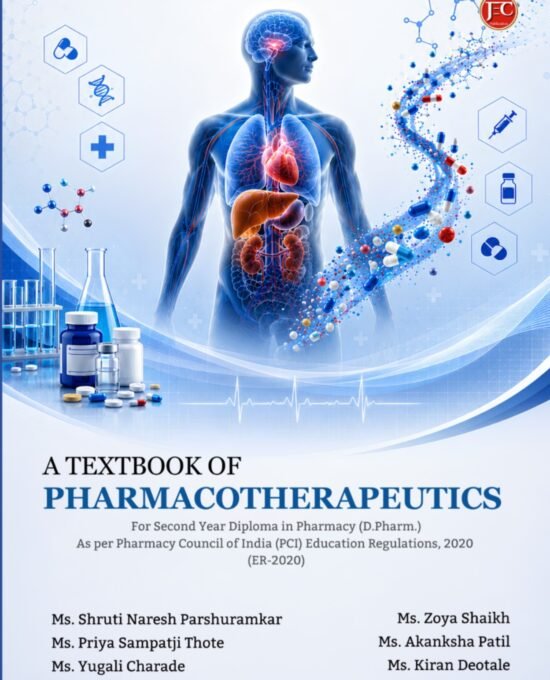
Pharmacotherapeutics is one of the most important subjects in the Diploma in Pharmacy (D.Pharm.) curriculum, as it provides students with the knowledge and skills required for the rational management of common diseases. A clear understanding of disease pathology, clinical manifestations, diagnosis, and appropriate therapeutic interventions is essential for providing safe and effective patient care. This book has been prepared strictly according to the latest Education Regulations (ER-2020) prescribed by the Pharmacy Council of India (PCI). The content has been presented in simple, clear, and student-friendly language to help learners understand concepts easily while strengthening their theoretical knowledge and examination preparation. Each chapter follows a systematic approach, beginning with an introduction to the disease, followed by etiopathogenesis, clinical manifestations, diagnosis, non-pharmacological and pharmacological management, commonly used drugs, and important exercise questions. Wherever appropriate, tables, flowcharts, and illustrations have been included to improve understanding and facilitate quick revision. Special emphasis has been placed on evidence-based pharmacotherapy, rational use of medicines, patient counselling, and current treatment guidelines. The text has been carefully revised and rephrased to ensure clarity, readability, and academic accuracy while maintaining a concise format suitable for D.Pharm. students. This book is intended to serve as a reliable learning resource for students, teachers, and pharmacy professionals. It will also be useful for classroom teaching, self-study, practical learning, and competitive examination preparation. Although every effort has been made to ensure the accuracy and completeness of the content, constructive suggestions from teachers, students, and readers are always welcome. Their valuable feedback will help improve future editions of this book. We sincerely hope that this book will enhance the understanding of pharmacotherapeutics and contribute to the academic success and professional development of pharmacy students. Authors Ms. Shruti Parshuramkar Ms. Priya Thote Ms. Yugali Charade Ms. Zoya Shaikh Ms. Akanksha Patil Ms. Kiran Deotale
A Textbook Of Pharmacotherapeutics
₹499.00
Pharmacotherapeutics is one of the most important subjects in the Diploma in Pharmacy (D.Pharm.) curriculum, as it provides students with the knowledge and skills required for the rational management of common diseases. A clear understanding of disease pathology, clinical manifestations, diagnosis, and appropriate therapeutic interventions is essential for providing safe and effective patient care. This book has been prepared strictly according to the latest Education Regulations (ER-2020) prescribed by the Pharmacy Council of India (PCI). The content has been presented in simple, clear, and student-friendly language to help learners understand concepts easily while strengthening their theoretical knowledge and examination preparation. Each chapter follows a systematic approach, beginning with an introduction to the disease, followed by etiopathogenesis, clinical manifestations, diagnosis, non-pharmacological and pharmacological management, commonly used drugs, and important exercise questions. Wherever appropriate, tables, flowcharts, and illustrations have been included to improve understanding and facilitate quick revision. Special emphasis has been placed on evidence-based pharmacotherapy, rational use of medicines, patient counselling, and current treatment guidelines. The text has been carefully revised and rephrased to ensure clarity, readability, and academic accuracy while maintaining a concise format suitable for D.Pharm. students. This book is intended to serve as a reliable learning resource for students, teachers, and pharmacy professionals. It will also be useful for classroom teaching, self-study, practical learning, and competitive examination preparation. Although every effort has been made to ensure the accuracy and completeness of the content, constructive suggestions from teachers, students, and readers are always welcome. Their valuable feedback will help improve future editions of this book. We sincerely hope that this book will enhance the understanding of pharmacotherapeutics and contribute to the academic success and professional development of pharmacy students. Authors Ms. Shruti Parshuramkar Ms. Priya Thote Ms. Yugali Charade Ms. Zoya Shaikh Ms. Akanksha Patil Ms. Kiran Deotale

Accounting for the Earth A Sustainable Future Approach
₹499.00
Accounting for the Earth: A Sustainable Future Approach is a comprehensive
academic volume that explores the evolving role of accounting in addressing environmental and sustainability challenges. The book examines how traditional financial accounting systems are transforming to incorporate environmental, social, and governance (ESG) dimensions, enabling organizations to measure not only financial performance but also ecological and social impact. It presents contemporary frameworks such as green accounting, carbon accounting, sustainability reporting, and integrated reporting, while highlighting regulatory developments and emerging global standards. The chapters also discuss the role of technology, including artificial intelligence, data analytics, and digital reporting, in enhancing transparency and accountability. By bridging theory and practical application, the book provides insights for academicians, researchers, policymakers, and industry professionals. Overall, this volume emphasizes responsible decision-making, sustainable development, and long-term value creation, making it a valuable resource for understanding sustainable accounting practices in a rapidly changing global economy
Accounting for the Earth A Sustainable Future Approach
₹499.00
Accounting for the Earth: A Sustainable Future Approach is a comprehensive
academic volume that explores the evolving role of accounting in addressing environmental and sustainability challenges. The book examines how traditional financial accounting systems are transforming to incorporate environmental, social, and governance (ESG) dimensions, enabling organizations to measure not only financial performance but also ecological and social impact. It presents contemporary frameworks such as green accounting, carbon accounting, sustainability reporting, and integrated reporting, while highlighting regulatory developments and emerging global standards. The chapters also discuss the role of technology, including artificial intelligence, data analytics, and digital reporting, in enhancing transparency and accountability. By bridging theory and practical application, the book provides insights for academicians, researchers, policymakers, and industry professionals. Overall, this volume emphasizes responsible decision-making, sustainable development, and long-term value creation, making it a valuable resource for understanding sustainable accounting practices in a rapidly changing global economy

ACL Repair Complications: From Biomechanics to Rehabilitation
₹999.00
Anterior cruciate ligament (ACL) injuries are among the most frequent and
difficult problems faced in sports medicine and orthopaedic practice.
Despite substantial improvement in surgical intervention and rehabilitation
protocol of ACLR, post-operative complications are still an important issue
that can affect function, delay return to previous activities and potentially
increase the risk of re-injury or future articular degeneration. These
difficulties surface via an intricate interrelationship between biomechanical
factors, surgical variables, biological healing influences and rehabilitation
methods.
ACL Repair Complications: Biomechanics to Rehabilitation has been
designed as an integrated, multidisciplinary approach, addressing this
complexity. Awesomeness intro Introduction The theoretical foundation of
this book is that postoperative complications after ACL reconstruction
cannot be properly dealt with and managed in an isolated way. Yet these
elements should be considered along the entire continuum of care—from
injury biomechanics, through surgical treatment and tissue healing to
evidence-based rehabilitation and functional recovery in the long aeon.
This book connects basic biomechanical skills with clinical applications. It
discusses how abnormal joint loading, neuromuscular control deficiencies,
graft selection and placement, and aberrant movement patterns lead to such
complications as graft failure, residual instability, stiffness, pain syndromes,
and early onset osteoarthritis. The same emphasis on rehabilitation as
surgery is considered, understanding that this can also limit recovery if the loading is wrong, progression of exercise or neuromuscular control training
is miss-managed for all technically successful surgeries.
This volume, written by orthopedic surgeons, sports physicians,,
physiotherapists, rehabilitation scientists and athletic trainers and
postgraduate students is a comprehensive textbook for the management of
such advanced treatments. The content is evidence-based where specialists,
scientists and researchers in the field from around the world have written
chapters that synthesise available research on a particular method including
current research evidence, clinical insight, practical application and
guidelines for decision making. Case-based and applied framework
chapters present biomechanical perspectives on specific topics that
demonstrate how theory translates into practice through in-depth study of
clinical examples and practical applications for rehabilitation.
Ultimately, the book is intended to foster a comprehensive and patientoriented approach to ACL care that extends beyond operative success while
emphasizing long-term joint health, performance function, and quality of
life. Combining biomechanics and rehabilitation in a single plot, we aim to
help improve surgical safety and enhance the future of rehabilitation and
patient outcomes for those rehabilitating from ACL repair.
ACL Repair Complications: From Biomechanics to Rehabilitation
₹999.00
Anterior cruciate ligament (ACL) injuries are among the most frequent and
difficult problems faced in sports medicine and orthopaedic practice.
Despite substantial improvement in surgical intervention and rehabilitation
protocol of ACLR, post-operative complications are still an important issue
that can affect function, delay return to previous activities and potentially
increase the risk of re-injury or future articular degeneration. These
difficulties surface via an intricate interrelationship between biomechanical
factors, surgical variables, biological healing influences and rehabilitation
methods.
ACL Repair Complications: Biomechanics to Rehabilitation has been
designed as an integrated, multidisciplinary approach, addressing this
complexity. Awesomeness intro Introduction The theoretical foundation of
this book is that postoperative complications after ACL reconstruction
cannot be properly dealt with and managed in an isolated way. Yet these
elements should be considered along the entire continuum of care—from
injury biomechanics, through surgical treatment and tissue healing to
evidence-based rehabilitation and functional recovery in the long aeon.
This book connects basic biomechanical skills with clinical applications. It
discusses how abnormal joint loading, neuromuscular control deficiencies,
graft selection and placement, and aberrant movement patterns lead to such
complications as graft failure, residual instability, stiffness, pain syndromes,
and early onset osteoarthritis. The same emphasis on rehabilitation as
surgery is considered, understanding that this can also limit recovery if the loading is wrong, progression of exercise or neuromuscular control training
is miss-managed for all technically successful surgeries.
This volume, written by orthopedic surgeons, sports physicians,,
physiotherapists, rehabilitation scientists and athletic trainers and
postgraduate students is a comprehensive textbook for the management of
such advanced treatments. The content is evidence-based where specialists,
scientists and researchers in the field from around the world have written
chapters that synthesise available research on a particular method including
current research evidence, clinical insight, practical application and
guidelines for decision making. Case-based and applied framework
chapters present biomechanical perspectives on specific topics that
demonstrate how theory translates into practice through in-depth study of
clinical examples and practical applications for rehabilitation.
Ultimately, the book is intended to foster a comprehensive and patientoriented approach to ACL care that extends beyond operative success while
emphasizing long-term joint health, performance function, and quality of
life. Combining biomechanics and rehabilitation in a single plot, we aim to
help improve surgical safety and enhance the future of rehabilitation and
patient outcomes for those rehabilitating from ACL repair.
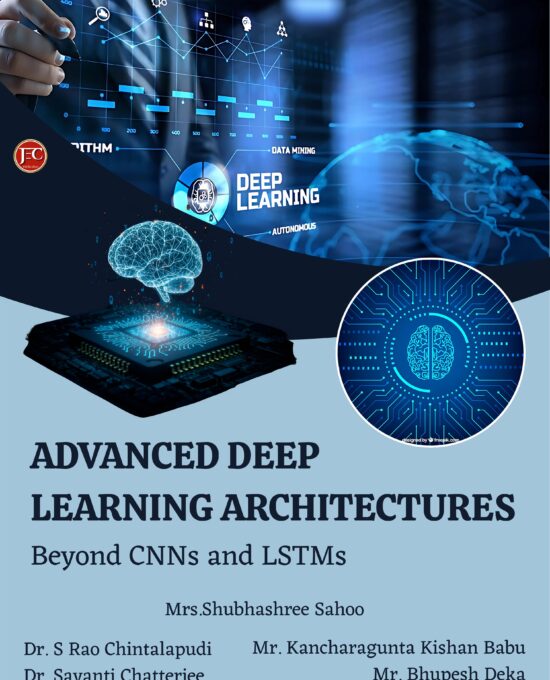
ADVANCED DEEP LEARNING ARCHITECTURES Beyond CNNs and LSTMs
₹499.00
Deep learning has fundamentally transformed the landscape of artificial intelligence, powering
breakthroughs in computer vision, natural language processing, speech recognition, and beyond.
Over the past decade, Convolutional Neural Networks (CNNs) and Long Short-Term Memory
networks (LSTMs) emerged as the dominant architectures for tackling structured image data and
sequential information, respectively. CNNs, with their hierarchical feature extraction and local
receptive fields, revolutionized image classification, object detection, and semantic segmentation,
enabling systems to achieve near-human or even superhuman performance on benchmarks such
as ImageNet. LSTMs, on the other hand, overcame the limitations of traditional recurrent neural
networks, effectively addressing the vanishing gradient problem and enabling long-range
temporal dependencies to be learned, thereby advancing language modeling, machine translation,
and speech synthesis.
However, as datasets expanded to billions of samples, tasks grew increasingly complex, and the
need for generalization across heterogeneous domains intensified, the inherent limitations of
CNNs and LSTMs became apparent. CNNs struggle with modeling long-range dependencies,
processing irregular graph-structured data, or integrating multimodal inputs, while LSTMs face
challenges in parallelization, handling very long sequences efficiently, and scaling to massive
model sizes. Moreover, simply increasing depth, width, or training data does not always guarantee
proportional improvements in performance, highlighting the plateauing effect of these
architectures in cutting-edge AI applications.
This book, Advanced Deep Learning Architectures: Beyond CNNs and LSTMs, is designed to chart
the evolution of next-generation architectures that address these limitations and define the future
of artificial intelligence. It offers a comprehensive journey through the design principles,
mathematical foundations, and practical implementations of state-of-the-art models. The scope
spans transformers — including BERT, GPT, and Vision Transformers — which leverage selfattention to model long-range dependencies and multimodal relationships; graph neural networks,
which enable AI systems to reason about relational and non-Euclidean data; capsule networks,
which improve spatial hierarchies and pose awareness; neural ordinary differential equations,
which introduce continuous-time modeling; and diffusion models, which have redefined
generative AI through probabilistic modeling and denoising frameworks. The book also delves
into hybrid and multimodal architectures, advanced reinforcement learning frameworks, and
emerging paradigms such as neuromorphic computing, quantum deep learning, and evolutionary algorithms. Importantly, the text bridges theory and practice. Each chapter combines rigorous
mathematical derivations — from linear algebra and tensor calculus to probabilistic modeling and
information-theoretic analysis — with hands-on Python implementations using libraries such as
PyTorch, TensorFlow, and NumPy. Readers are guided through step-by-step coding exercises,
practical tips for optimization, and demonstrations of applying these models to real-world datasets.
This dual approach ensures a deep understanding not just of why these architectures work, but
how to implement, experiment, and extend them.
Beyond technical mastery, the book emphasizes the broader implications of advanced AI:
multimodal intelligence, ethical alignment, interpretability, and the path toward general-purpose
AI systems.
ADVANCED DEEP LEARNING ARCHITECTURES Beyond CNNs and LSTMs
₹499.00
Deep learning has fundamentally transformed the landscape of artificial intelligence, powering
breakthroughs in computer vision, natural language processing, speech recognition, and beyond.
Over the past decade, Convolutional Neural Networks (CNNs) and Long Short-Term Memory
networks (LSTMs) emerged as the dominant architectures for tackling structured image data and
sequential information, respectively. CNNs, with their hierarchical feature extraction and local
receptive fields, revolutionized image classification, object detection, and semantic segmentation,
enabling systems to achieve near-human or even superhuman performance on benchmarks such
as ImageNet. LSTMs, on the other hand, overcame the limitations of traditional recurrent neural
networks, effectively addressing the vanishing gradient problem and enabling long-range
temporal dependencies to be learned, thereby advancing language modeling, machine translation,
and speech synthesis.
However, as datasets expanded to billions of samples, tasks grew increasingly complex, and the
need for generalization across heterogeneous domains intensified, the inherent limitations of
CNNs and LSTMs became apparent. CNNs struggle with modeling long-range dependencies,
processing irregular graph-structured data, or integrating multimodal inputs, while LSTMs face
challenges in parallelization, handling very long sequences efficiently, and scaling to massive
model sizes. Moreover, simply increasing depth, width, or training data does not always guarantee
proportional improvements in performance, highlighting the plateauing effect of these
architectures in cutting-edge AI applications.
This book, Advanced Deep Learning Architectures: Beyond CNNs and LSTMs, is designed to chart
the evolution of next-generation architectures that address these limitations and define the future
of artificial intelligence. It offers a comprehensive journey through the design principles,
mathematical foundations, and practical implementations of state-of-the-art models. The scope
spans transformers — including BERT, GPT, and Vision Transformers — which leverage selfattention to model long-range dependencies and multimodal relationships; graph neural networks,
which enable AI systems to reason about relational and non-Euclidean data; capsule networks,
which improve spatial hierarchies and pose awareness; neural ordinary differential equations,
which introduce continuous-time modeling; and diffusion models, which have redefined
generative AI through probabilistic modeling and denoising frameworks. The book also delves
into hybrid and multimodal architectures, advanced reinforcement learning frameworks, and
emerging paradigms such as neuromorphic computing, quantum deep learning, and evolutionary algorithms. Importantly, the text bridges theory and practice. Each chapter combines rigorous
mathematical derivations — from linear algebra and tensor calculus to probabilistic modeling and
information-theoretic analysis — with hands-on Python implementations using libraries such as
PyTorch, TensorFlow, and NumPy. Readers are guided through step-by-step coding exercises,
practical tips for optimization, and demonstrations of applying these models to real-world datasets.
This dual approach ensures a deep understanding not just of why these architectures work, but
how to implement, experiment, and extend them.
Beyond technical mastery, the book emphasizes the broader implications of advanced AI:
multimodal intelligence, ethical alignment, interpretability, and the path toward general-purpose
AI systems.
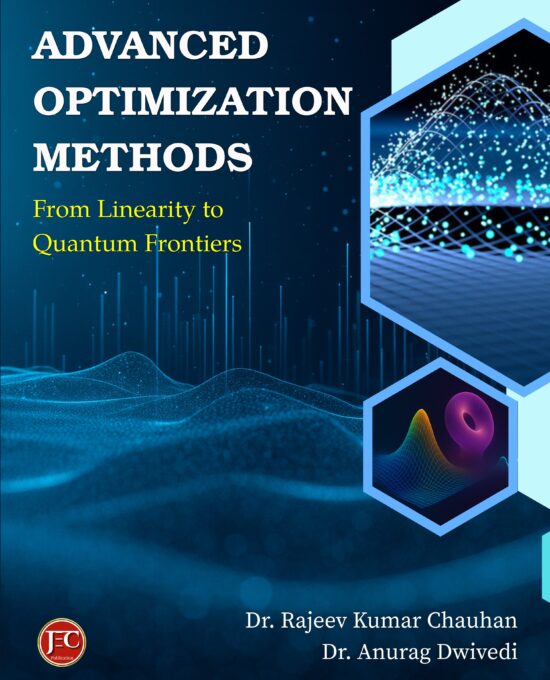
Advanced Optimization Methods From Linearity To Quantum Frontiers
₹499.00
Optimization lies at the core of modern science, engineering, and decision-making, providing
systematic methods to identify the best possible solutions under given constraints. This book presents
a comprehensive and integrated treatment of optimization, beginning with foundational concepts and
mathematical prerequisites and progressing through linear, nonlinear, combinatorial, dynamic,
stochastic, and convex optimization frameworks. Emphasis is placed on both theoretical
understanding and algorithmic implementation, ensuring that readers not only grasp underlying
principles but also learn how to apply them to real-world problems. Historical developments are
interwoven with contemporary methods to highlight the evolution of optimization as a discipline.
Each chapter is structured to balance rigor with intuition, supported by classical examples,
algorithms, and practical applications across engineering, economics, artificial intelligence, and the
natural sciences. Designed for students, researchers, and practitioners, this book aims to build strong
conceptual foundations while also introducing advanced topics and emerging frontiers. Ultimately, it
seeks to cultivate analytical thinking and equip readers with versatile optimization tools for solving
complex, real-world challenges.
Advanced Optimization Methods From Linearity To Quantum Frontiers
₹499.00
Optimization lies at the core of modern science, engineering, and decision-making, providing
systematic methods to identify the best possible solutions under given constraints. This book presents
a comprehensive and integrated treatment of optimization, beginning with foundational concepts and
mathematical prerequisites and progressing through linear, nonlinear, combinatorial, dynamic,
stochastic, and convex optimization frameworks. Emphasis is placed on both theoretical
understanding and algorithmic implementation, ensuring that readers not only grasp underlying
principles but also learn how to apply them to real-world problems. Historical developments are
interwoven with contemporary methods to highlight the evolution of optimization as a discipline.
Each chapter is structured to balance rigor with intuition, supported by classical examples,
algorithms, and practical applications across engineering, economics, artificial intelligence, and the
natural sciences. Designed for students, researchers, and practitioners, this book aims to build strong
conceptual foundations while also introducing advanced topics and emerging frontiers. Ultimately, it
seeks to cultivate analytical thinking and equip readers with versatile optimization tools for solving
complex, real-world challenges.