A Practical Book Of Pharmaceutics-I
Published on 2025
₹499.00
It gives me immense pleasure to present to pharmacy students my book entitled "A Practical Book
of Pharmaceutics-I". Writing a book is inspiring, often exciting, and sometimes very challenging
work.
Pharmaceutics practical involve the practical application of scientific principles to the formulation
and development of pharmaceutical products. These practical sessions typically include various
aspects such as drug formulation, dosage form design, and manufacturing techniques. Students learn
to handle equipment, perform experiments, and gain hands-on experience in pharmaceutical
processes. Key components may include compounding, granulation, tablet pressing, and quality
control methods. Proficiency in basic techniques like accurate measurements, proper handling of
equipment, and adherence to good laboratory practices is fundamental, laying the groundwork for
more advanced studies in pharmaceutics. Without a strong foundation in these practical skills,
progressing to advanced pharmaceutical development becomes challenging and resource-intensive.
The book contains calculations and important questions related to the experiments to fulfill the
requirements of students.
I record my sincere thanks to Dr. Navneet Verma, Dr. Arun Kumar Mishra, Dr. Sushil Kumar, Dr.
Munish Mani, Dr. Shweta Verma, and all my coauthors for constant encouragement to write this
book.
I thank my parents for their constant support to review the content of this book and moral support. I
am thankful to my seniors, friends and students who gave me suggestions whenever I asked for
betterment of this book.
I appreciate the cooperation and interest taken by Publishers JEC Publication in bringing out this
book.
I will be grateful to all the teachers and students who will be kind enough to point out my mistakes
that have escaped my attention. Suggestions for future improvement are always welcome.
A Practical Book Of Pharmaceutics-I
₹499.00
It gives me immense pleasure to present to pharmacy students my book entitled "A Practical Book
of Pharmaceutics-I". Writing a book is inspiring, often exciting, and sometimes very challenging
work.
Pharmaceutics practical involve the practical application of scientific principles to the formulation
and development of pharmaceutical products. These practical sessions typically include various
aspects such as drug formulation, dosage form design, and manufacturing techniques. Students learn
to handle equipment, perform experiments, and gain hands-on experience in pharmaceutical
processes. Key components may include compounding, granulation, tablet pressing, and quality
control methods. Proficiency in basic techniques like accurate measurements, proper handling of
equipment, and adherence to good laboratory practices is fundamental, laying the groundwork for
more advanced studies in pharmaceutics. Without a strong foundation in these practical skills,
progressing to advanced pharmaceutical development becomes challenging and resource-intensive.
The book contains calculations and important questions related to the experiments to fulfill the
requirements of students.
I record my sincere thanks to Dr. Navneet Verma, Dr. Arun Kumar Mishra, Dr. Sushil Kumar, Dr.
Munish Mani, Dr. Shweta Verma, and all my coauthors for constant encouragement to write this
book.
I thank my parents for their constant support to review the content of this book and moral support. I
am thankful to my seniors, friends and students who gave me suggestions whenever I asked for
betterment of this book.
I appreciate the cooperation and interest taken by Publishers JEC Publication in bringing out this
book.
I will be grateful to all the teachers and students who will be kind enough to point out my mistakes
that have escaped my attention. Suggestions for future improvement are always welcome.



ANATOMY OF PLANTS
₹499.00
The study of plant anatomy is not only central to understanding the structural organization of plants but also to appreciating the intricate processes that govern their growth, reproduction, and survival. Plants, as primary producers, form the foundation of life on Earth, and their internal structure provides valuable insights into their adaptability, ecological roles, and evolutionary success. This book, Anatomy of Plants, is designed to serve as a comprehensive guide for students, educators, and researchers who wish to delve into the fundamental aspects of plant structure and function.
The chapters in this volume have been carefully arranged to provide a logical progression from the basics of wood anatomy and growth rings to the complex processes of gametophyte development, pollination, fertilization, and embryogenesis. Each concept has been explained with clarity, supported by comparative tables, diagrams, and self-assessment questions to aid both understanding and retention. In addition to the classical foundations of plant anatomy, the book incorporates applied aspects such as dendrochronology, reproductive adaptations, and mechanisms like apomixis and parthenocarpy, which are of significance in both ecological studies and agricultural practices.
This book has been written with undergraduate and postgraduate learners in mind, but it will also be useful for aspirants of competitive examinations and researchers seeking a consolidated resource. By combining theoretical detail with practical assessment exercises, it bridges the gap between academic knowledge and applied learning. I sincerely hope that readers will find this work informative, engaging, and enriching in their exploration of the fascinating world of plant anatomy.
ANATOMY OF PLANTS
₹499.00
The study of plant anatomy is not only central to understanding the structural organization of plants but also to appreciating the intricate processes that govern their growth, reproduction, and survival. Plants, as primary producers, form the foundation of life on Earth, and their internal structure provides valuable insights into their adaptability, ecological roles, and evolutionary success. This book, Anatomy of Plants, is designed to serve as a comprehensive guide for students, educators, and researchers who wish to delve into the fundamental aspects of plant structure and function.
The chapters in this volume have been carefully arranged to provide a logical progression from the basics of wood anatomy and growth rings to the complex processes of gametophyte development, pollination, fertilization, and embryogenesis. Each concept has been explained with clarity, supported by comparative tables, diagrams, and self-assessment questions to aid both understanding and retention. In addition to the classical foundations of plant anatomy, the book incorporates applied aspects such as dendrochronology, reproductive adaptations, and mechanisms like apomixis and parthenocarpy, which are of significance in both ecological studies and agricultural practices.
This book has been written with undergraduate and postgraduate learners in mind, but it will also be useful for aspirants of competitive examinations and researchers seeking a consolidated resource. By combining theoretical detail with practical assessment exercises, it bridges the gap between academic knowledge and applied learning. I sincerely hope that readers will find this work informative, engaging, and enriching in their exploration of the fascinating world of plant anatomy.

Artificial Intelligence In Cybersecurity
₹349.00
Artificial Intelligence (AI) refers to the application of intelligent algorithms
and machine learning techniques to enhance the detection, prevention, and
response to cyber threats. AI empowers cybersecurity systems to analyze vast
amounts of data, identify patterns, and make informed decisions, at speeds and
scales beyond human capabilities.
The role of AI in bolstering security measures is multifaceted. It can automate
routine tasks such as log analysis and vulnerability scanning, freeing up
human analysts to focus on more complex and strategic activities. AI in
cybersecurity plays a crucial role in threat detection. AI-powered systems can
detect threats in real-time, enabling rapid response and mitigation. Moreover,
AI can adapt and evolve, continuously learning from new data and improving
its ability to identify and counter emerging threats.AI in cybersecurity
revolutionizes threat detection, automates responses, and strengthens
vulnerability management. By analyzing behaviors, detecting phishing, and
adapting to new threats, AI enhances cybersecurity strategies, enabling
proactive defense and safeguarding sensitive data.
We are really very happy to write a book on this very important
Dr. S. Angel,
Dr. R. Saravana Moorthy,
Dr. S. Radharani,
Mrs.N.Paviyasre
Artificial Intelligence In Cybersecurity
₹349.00
Artificial Intelligence (AI) refers to the application of intelligent algorithms
and machine learning techniques to enhance the detection, prevention, and
response to cyber threats. AI empowers cybersecurity systems to analyze vast
amounts of data, identify patterns, and make informed decisions, at speeds and
scales beyond human capabilities.
The role of AI in bolstering security measures is multifaceted. It can automate
routine tasks such as log analysis and vulnerability scanning, freeing up
human analysts to focus on more complex and strategic activities. AI in
cybersecurity plays a crucial role in threat detection. AI-powered systems can
detect threats in real-time, enabling rapid response and mitigation. Moreover,
AI can adapt and evolve, continuously learning from new data and improving
its ability to identify and counter emerging threats.AI in cybersecurity
revolutionizes threat detection, automates responses, and strengthens
vulnerability management. By analyzing behaviors, detecting phishing, and
adapting to new threats, AI enhances cybersecurity strategies, enabling
proactive defense and safeguarding sensitive data.
We are really very happy to write a book on this very important
Dr. S. Angel,
Dr. R. Saravana Moorthy,
Dr. S. Radharani,
Mrs.N.Paviyasre


DATA ANALYSIS AND VISUALIZATION USING PYTHON
₹499.00
In today’s digital era, data has become the new oil—fueling industries, science, governance, and
everyday decision-making. This handbook, Data Analysis and Visualization Using Python, is designed to
bridge the gap between raw data and actionable insights. It introduces the fundamental principles of data
analysis, demonstrates the power of Python as the lingua franca of data science, and showcases how
visualization transforms abstract numbers into meaningful stories. By combining theory, practical coding
examples, and real-world applications, this work serves as a comprehensive guide for learners and
professionals who wish to master the art of turning data into knowledge.
DATA ANALYSIS AND VISUALIZATION USING PYTHON
₹499.00
In today’s digital era, data has become the new oil—fueling industries, science, governance, and
everyday decision-making. This handbook, Data Analysis and Visualization Using Python, is designed to
bridge the gap between raw data and actionable insights. It introduces the fundamental principles of data
analysis, demonstrates the power of Python as the lingua franca of data science, and showcases how
visualization transforms abstract numbers into meaningful stories. By combining theory, practical coding
examples, and real-world applications, this work serves as a comprehensive guide for learners and
professionals who wish to master the art of turning data into knowledge.
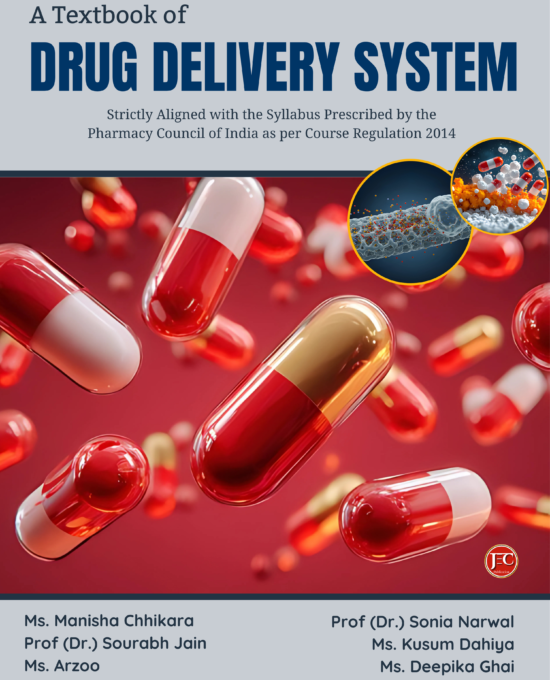
DRUG DELIVERY SYSTEM
₹499.00
The motivation behind writing this book stems from the growing need for innovative and effective delivery systems in the treatment of various diseases. Traditional methods of drug administration often face challenges such as poor bioavailability, patient compliance issues, and systemic side effects. The development of sophisticated drug delivery systems offers promising solutions to these challenges by enhancing the efficacy, safety, and patient adherence of therapeutic agents.
This book is the result of a shared vision and collaboration among a team of committed educators and researchers. We have come together with the common goal of sharing our collective knowledge, experience, and passion for the subject. Each contributor has brought their own unique perspective and expertise, which has enriched the content and provided a broad, balanced understanding of key concepts in pharmaceutics.
This book is designed to serve as a valuable resource for students, researchers, and professionals in the field of pharmaceutical sciences. It covers a wide range of topics, including the fundamentals of drug delivery, various delivery routes, advanced delivery systems such as nanoparticles and liposomes, and the latest trends in personalized medicine and nanotechnology. Each chapter is meticulously structured to provide theoretical knowledge supported by current research and case studies.
Our aim has been to present the material in a way that is not only informative but also engaging and student-friendly. We have carefully structured the chapters to ensure clarity, relevance, and coherence, keeping in mind the academic needs of undergraduate students, while also offering valuable insights for researchers and professionals. We are profoundly grateful to everyone who has supported us in completing this project. Our sincere thanks go to our mentors and colleagues for their guidance and encouragement, to the peer reviewers for their critical feedback and constructive suggestions, and most importantly, to our families for their patience and steadfast support throughout this endeavor.
We hope that this book serves as a valuable companion in your academic and professional journey, sparking curiosity, deepening your understanding, and inspiring further exploration into the fascinating world of Pharmaceutical Sciences.
DRUG DELIVERY SYSTEM
₹499.00
The motivation behind writing this book stems from the growing need for innovative and effective delivery systems in the treatment of various diseases. Traditional methods of drug administration often face challenges such as poor bioavailability, patient compliance issues, and systemic side effects. The development of sophisticated drug delivery systems offers promising solutions to these challenges by enhancing the efficacy, safety, and patient adherence of therapeutic agents.
This book is the result of a shared vision and collaboration among a team of committed educators and researchers. We have come together with the common goal of sharing our collective knowledge, experience, and passion for the subject. Each contributor has brought their own unique perspective and expertise, which has enriched the content and provided a broad, balanced understanding of key concepts in pharmaceutics.
This book is designed to serve as a valuable resource for students, researchers, and professionals in the field of pharmaceutical sciences. It covers a wide range of topics, including the fundamentals of drug delivery, various delivery routes, advanced delivery systems such as nanoparticles and liposomes, and the latest trends in personalized medicine and nanotechnology. Each chapter is meticulously structured to provide theoretical knowledge supported by current research and case studies.
Our aim has been to present the material in a way that is not only informative but also engaging and student-friendly. We have carefully structured the chapters to ensure clarity, relevance, and coherence, keeping in mind the academic needs of undergraduate students, while also offering valuable insights for researchers and professionals. We are profoundly grateful to everyone who has supported us in completing this project. Our sincere thanks go to our mentors and colleagues for their guidance and encouragement, to the peer reviewers for their critical feedback and constructive suggestions, and most importantly, to our families for their patience and steadfast support throughout this endeavor.
We hope that this book serves as a valuable companion in your academic and professional journey, sparking curiosity, deepening your understanding, and inspiring further exploration into the fascinating world of Pharmaceutical Sciences.

FINANCIAL INSTITUTIONS & MARKETS The Indian Context
₹499.00
The financial system forms the backbone of any modern economy, enabling the flow of funds,
facilitating investment, managing risks, and supporting inclusive growth. In India, the evolution
of financial institutions and markets has been particularly dynamic, reflecting the interplay of
policy reforms, technological advancements, globalization, and regulatory innovations.
Recognizing the crucial role that financial intermediation plays in shaping economic development,
this book seeks to provide students, academicians, researchers, and practitioners with a
comprehensive and updated understanding of financial institutions and markets in the Indian
context.
The book has been structured into fourteen units that systematically explore the functions,
structures, and roles of financial systems and markets. Beginning with an overview of the Indian
financial system and its regulatory architecture, it examines the interrelationship between money
markets, capital markets, banking systems, non-banking financial companies, development
financial institutions, insurance, mutual funds, and other specialized intermediaries. The
discussion extends to emerging areas such as derivatives, foreign exchange markets, financial
sector regulators, digital finance, and the implications of globalization for Indian financial
markets. Each unit blends theoretical foundations with practical insights, integrating case studies,
recent policy developments, and contemporary challenges to enrich the reader’s understanding.
A unique feature of this book is its emphasis on the Indian context, where reforms in banking,
insurance, and capital markets have not only strengthened financial intermediation but also
promoted financial inclusion and stability. The inclusion of fintech innovations, regulatory
sandboxes, and digital platforms reflects the ongoing transformation of India’s financial
landscape. In addition, the book underscores the interconnectedness between domestic and global
markets, preparing readers to appreciate both local realities and international trends.
The text is designed to serve as a core resource for undergraduate and postgraduate courses in
commerce, economics, and management, while also being a valuable reference for aspirants of
competitive examinations such as UGC-NET, CA, CS, CFA, and banking services. Each chapter
is supported by learning objectives, outcomes, review questions, and references, enabling a
structured and learner-friendly approach.
We express my deep gratitude to colleagues, mentors, and students whose feedback,
encouragement, and critical observations have greatly contributed to shaping this work. We also
acknowledge the vast body of literature, research contributions, and policy reports that informed the writing of this book. Above all, we are indebted to our family members for their constant
support and patience during the long and demanding process of writing.
It is our hope that this book will not only help learners understand the theoretical and institutional
aspects of Indian financial systems but also inspire them to critically engage with the challenges
and opportunities that lie ahead. Finance is no longer a domain limited to professionals; it is an
essential component of informed citizenship in a rapidly changing global economy. If this work
succeeds in making financial concepts accessible, relevant, and meaningful for its readers, it will
have fulfilled its purpose.
Authors
Prof Avirup Mukherjee
Dr P Sagar
Dr. Arpana Sharma
Dr.Navaneet D. Deshpande
FINANCIAL INSTITUTIONS & MARKETS The Indian Context
₹499.00
The financial system forms the backbone of any modern economy, enabling the flow of funds,
facilitating investment, managing risks, and supporting inclusive growth. In India, the evolution
of financial institutions and markets has been particularly dynamic, reflecting the interplay of
policy reforms, technological advancements, globalization, and regulatory innovations.
Recognizing the crucial role that financial intermediation plays in shaping economic development,
this book seeks to provide students, academicians, researchers, and practitioners with a
comprehensive and updated understanding of financial institutions and markets in the Indian
context.
The book has been structured into fourteen units that systematically explore the functions,
structures, and roles of financial systems and markets. Beginning with an overview of the Indian
financial system and its regulatory architecture, it examines the interrelationship between money
markets, capital markets, banking systems, non-banking financial companies, development
financial institutions, insurance, mutual funds, and other specialized intermediaries. The
discussion extends to emerging areas such as derivatives, foreign exchange markets, financial
sector regulators, digital finance, and the implications of globalization for Indian financial
markets. Each unit blends theoretical foundations with practical insights, integrating case studies,
recent policy developments, and contemporary challenges to enrich the reader’s understanding.
A unique feature of this book is its emphasis on the Indian context, where reforms in banking,
insurance, and capital markets have not only strengthened financial intermediation but also
promoted financial inclusion and stability. The inclusion of fintech innovations, regulatory
sandboxes, and digital platforms reflects the ongoing transformation of India’s financial
landscape. In addition, the book underscores the interconnectedness between domestic and global
markets, preparing readers to appreciate both local realities and international trends.
The text is designed to serve as a core resource for undergraduate and postgraduate courses in
commerce, economics, and management, while also being a valuable reference for aspirants of
competitive examinations such as UGC-NET, CA, CS, CFA, and banking services. Each chapter
is supported by learning objectives, outcomes, review questions, and references, enabling a
structured and learner-friendly approach.
We express my deep gratitude to colleagues, mentors, and students whose feedback,
encouragement, and critical observations have greatly contributed to shaping this work. We also
acknowledge the vast body of literature, research contributions, and policy reports that informed the writing of this book. Above all, we are indebted to our family members for their constant
support and patience during the long and demanding process of writing.
It is our hope that this book will not only help learners understand the theoretical and institutional
aspects of Indian financial systems but also inspire them to critically engage with the challenges
and opportunities that lie ahead. Finance is no longer a domain limited to professionals; it is an
essential component of informed citizenship in a rapidly changing global economy. If this work
succeeds in making financial concepts accessible, relevant, and meaningful for its readers, it will
have fulfilled its purpose.
Authors
Prof Avirup Mukherjee
Dr P Sagar
Dr. Arpana Sharma
Dr.Navaneet D. Deshpande

Herbal Drug Technology Practical Handbook
₹499.00
This handbook, aligned with the latest Pharmacy Council of India (PCI) New Syllabus, serves
as a comprehensive guide for Degree students in Semester VI B. Pharm. The intent is to
facilitate easy comprehension, providing practical insights into the field of Herbal Drug
technology. Acknowledging the paramount significance of Herbal drugs and their formulations
as a branch of knowledge, this handbook emphasizes its practical and scientific applications. It
aims to bridge the gap between theoretical understanding and real-world applications
This work not only outlines the aim and scope of Herbal drugs technologies but also highlights
its intrinsic connection with various scientific disciplines. The handbook is designed to
integrate these diverse elements for a holistic understanding. The handbook delves into the
herbal study, unravelling the active and other constituents of drugs and its therapeutic
applicability.
Our aim is to provide a comprehensive resource that enhances your practical knowledge and
skills in pharmacy. Specifically designed for Third-year B. Pharmacy students, the content is
presented in a clear, concise manner to align seamlessly with your coursework. We trust that
this practical guide will be an indispensable tool for both students and faculty in the Pharmacy
program. Our primary objective is to empower students, fostering competence and confidence
in becoming successful pharmacy professionals.
Best wishes to all pharmacy students and faculty embarking on this exciting journey. May this
guide be a valuable asset, inspiring passion for pharmaceutical sciences. Remember, pharmacy
is dynamic, and your commitment to continuous learning contributes to your success as future
healthcare providers.
We welcome any studious suggestions for improving this guide, recognizing that collaborative
efforts enhance its value.
Herbal Drug Technology Practical Handbook
₹499.00
This handbook, aligned with the latest Pharmacy Council of India (PCI) New Syllabus, serves
as a comprehensive guide for Degree students in Semester VI B. Pharm. The intent is to
facilitate easy comprehension, providing practical insights into the field of Herbal Drug
technology. Acknowledging the paramount significance of Herbal drugs and their formulations
as a branch of knowledge, this handbook emphasizes its practical and scientific applications. It
aims to bridge the gap between theoretical understanding and real-world applications
This work not only outlines the aim and scope of Herbal drugs technologies but also highlights
its intrinsic connection with various scientific disciplines. The handbook is designed to
integrate these diverse elements for a holistic understanding. The handbook delves into the
herbal study, unravelling the active and other constituents of drugs and its therapeutic
applicability.
Our aim is to provide a comprehensive resource that enhances your practical knowledge and
skills in pharmacy. Specifically designed for Third-year B. Pharmacy students, the content is
presented in a clear, concise manner to align seamlessly with your coursework. We trust that
this practical guide will be an indispensable tool for both students and faculty in the Pharmacy
program. Our primary objective is to empower students, fostering competence and confidence
in becoming successful pharmacy professionals.
Best wishes to all pharmacy students and faculty embarking on this exciting journey. May this
guide be a valuable asset, inspiring passion for pharmaceutical sciences. Remember, pharmacy
is dynamic, and your commitment to continuous learning contributes to your success as future
healthcare providers.
We welcome any studious suggestions for improving this guide, recognizing that collaborative
efforts enhance its value.