Analytical Perspectives in Herbal Medicines and Cosmetics
₹499.00
The increasing global demand for herbal medicines and natural cosmetic products has
highlighted the need for scientifically validated approaches to ensure their quality, safety,
efficacy, and regulatory compliance. Analytical techniques play a crucial role in the
authentication, standardization, characterization, and quality assessment of these products,
thereby bridging traditional knowledge with modern pharmaceutical science.
Analytical Perspectives in Herbal Medicines and Cosmetics for Pharmacy Professionals
has been developed to provide a comprehensive overview of contemporary analytical
methodologies used in the evaluation of herbal medicines and cosmetic formulations. The
book covers key aspects including phytochemical analysis, quality control,
chromatographic and spectroscopic techniques, method validation, stability studies, and
regulatory considerations relevant to the pharmaceutical and cosmetic sectors.
This book is intended to serve as a valuable resource for pharmacy students, researchers,
academicians, and industry professionals seeking a deeper understanding of analytical
approaches in natural product- based healthcare systems. We hope that this work will
contribute to advancing education, research, innovation, and quality assurance practices in
the field of herbal medicines and cosmetics.
We express our sincere gratitude to all contributors, reviewers, and well-wishers whose
support and expertise have made this publication possible. We trust that readers will find
this book informative, useful, and inspiring in their academic and professional pursuits.
Analytical Perspectives in Herbal Medicines and Cosmetics
₹499.00
The increasing global demand for herbal medicines and natural cosmetic products has
highlighted the need for scientifically validated approaches to ensure their quality, safety,
efficacy, and regulatory compliance. Analytical techniques play a crucial role in the
authentication, standardization, characterization, and quality assessment of these products,
thereby bridging traditional knowledge with modern pharmaceutical science.
Analytical Perspectives in Herbal Medicines and Cosmetics for Pharmacy Professionals
has been developed to provide a comprehensive overview of contemporary analytical
methodologies used in the evaluation of herbal medicines and cosmetic formulations. The
book covers key aspects including phytochemical analysis, quality control,
chromatographic and spectroscopic techniques, method validation, stability studies, and
regulatory considerations relevant to the pharmaceutical and cosmetic sectors.
This book is intended to serve as a valuable resource for pharmacy students, researchers,
academicians, and industry professionals seeking a deeper understanding of analytical
approaches in natural product- based healthcare systems. We hope that this work will
contribute to advancing education, research, innovation, and quality assurance practices in
the field of herbal medicines and cosmetics.
We express our sincere gratitude to all contributors, reviewers, and well-wishers whose
support and expertise have made this publication possible. We trust that readers will find
this book informative, useful, and inspiring in their academic and professional pursuits.
ANATOMY OF PLANTS
₹499.00
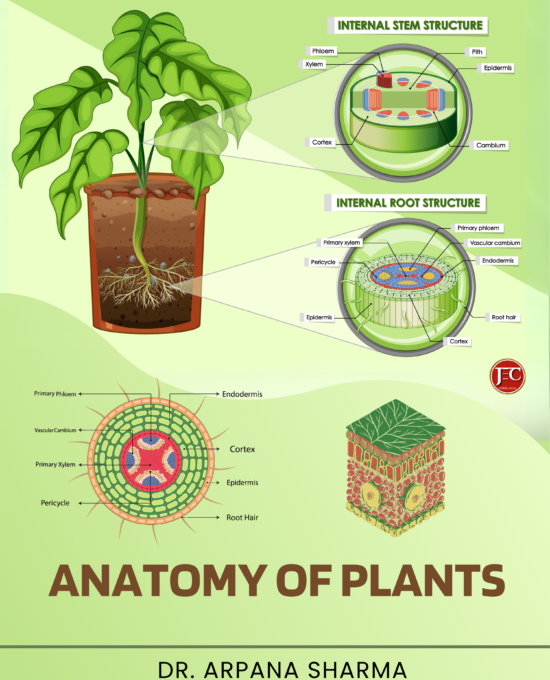
The study of plant anatomy is not only central to understanding the structural organization of plants but also to appreciating the intricate processes that govern their growth, reproduction, and survival. Plants, as primary producers, form the foundation of life on Earth, and their internal structure provides valuable insights into their adaptability, ecological roles, and evolutionary success. This book, Anatomy of Plants, is designed to serve as a comprehensive guide for students, educators, and researchers who wish to delve into the fundamental aspects of plant structure and function.
The chapters in this volume have been carefully arranged to provide a logical progression from the basics of wood anatomy and growth rings to the complex processes of gametophyte development, pollination, fertilization, and embryogenesis. Each concept has been explained with clarity, supported by comparative tables, diagrams, and self-assessment questions to aid both understanding and retention. In addition to the classical foundations of plant anatomy, the book incorporates applied aspects such as dendrochronology, reproductive adaptations, and mechanisms like apomixis and parthenocarpy, which are of significance in both ecological studies and agricultural practices.
This book has been written with undergraduate and postgraduate learners in mind, but it will also be useful for aspirants of competitive examinations and researchers seeking a consolidated resource. By combining theoretical detail with practical assessment exercises, it bridges the gap between academic knowledge and applied learning. I sincerely hope that readers will find this work informative, engaging, and enriching in their exploration of the fascinating world of plant anatomy.
ANATOMY OF PLANTS
₹499.00
The study of plant anatomy is not only central to understanding the structural organization of plants but also to appreciating the intricate processes that govern their growth, reproduction, and survival. Plants, as primary producers, form the foundation of life on Earth, and their internal structure provides valuable insights into their adaptability, ecological roles, and evolutionary success. This book, Anatomy of Plants, is designed to serve as a comprehensive guide for students, educators, and researchers who wish to delve into the fundamental aspects of plant structure and function.
The chapters in this volume have been carefully arranged to provide a logical progression from the basics of wood anatomy and growth rings to the complex processes of gametophyte development, pollination, fertilization, and embryogenesis. Each concept has been explained with clarity, supported by comparative tables, diagrams, and self-assessment questions to aid both understanding and retention. In addition to the classical foundations of plant anatomy, the book incorporates applied aspects such as dendrochronology, reproductive adaptations, and mechanisms like apomixis and parthenocarpy, which are of significance in both ecological studies and agricultural practices.
This book has been written with undergraduate and postgraduate learners in mind, but it will also be useful for aspirants of competitive examinations and researchers seeking a consolidated resource. By combining theoretical detail with practical assessment exercises, it bridges the gap between academic knowledge and applied learning. I sincerely hope that readers will find this work informative, engaging, and enriching in their exploration of the fascinating world of plant anatomy.