

ACL Repair Complications: From Biomechanics to Rehabilitation
₹999.00
Anterior cruciate ligament (ACL) injuries are among the most frequent and
difficult problems faced in sports medicine and orthopaedic practice.
Despite substantial improvement in surgical intervention and rehabilitation
protocol of ACLR, post-operative complications are still an important issue
that can affect function, delay return to previous activities and potentially
increase the risk of re-injury or future articular degeneration. These
difficulties surface via an intricate interrelationship between biomechanical
factors, surgical variables, biological healing influences and rehabilitation
methods.
ACL Repair Complications: Biomechanics to Rehabilitation has been
designed as an integrated, multidisciplinary approach, addressing this
complexity. Awesomeness intro Introduction The theoretical foundation of
this book is that postoperative complications after ACL reconstruction
cannot be properly dealt with and managed in an isolated way. Yet these
elements should be considered along the entire continuum of care—from
injury biomechanics, through surgical treatment and tissue healing to
evidence-based rehabilitation and functional recovery in the long aeon.
This book connects basic biomechanical skills with clinical applications. It
discusses how abnormal joint loading, neuromuscular control deficiencies,
graft selection and placement, and aberrant movement patterns lead to such
complications as graft failure, residual instability, stiffness, pain syndromes,
and early onset osteoarthritis. The same emphasis on rehabilitation as
surgery is considered, understanding that this can also limit recovery if the loading is wrong, progression of exercise or neuromuscular control training
is miss-managed for all technically successful surgeries.
This volume, written by orthopedic surgeons, sports physicians,,
physiotherapists, rehabilitation scientists and athletic trainers and
postgraduate students is a comprehensive textbook for the management of
such advanced treatments. The content is evidence-based where specialists,
scientists and researchers in the field from around the world have written
chapters that synthesise available research on a particular method including
current research evidence, clinical insight, practical application and
guidelines for decision making. Case-based and applied framework
chapters present biomechanical perspectives on specific topics that
demonstrate how theory translates into practice through in-depth study of
clinical examples and practical applications for rehabilitation.
Ultimately, the book is intended to foster a comprehensive and patientoriented approach to ACL care that extends beyond operative success while
emphasizing long-term joint health, performance function, and quality of
life. Combining biomechanics and rehabilitation in a single plot, we aim to
help improve surgical safety and enhance the future of rehabilitation and
patient outcomes for those rehabilitating from ACL repair.
ACL Repair Complications: From Biomechanics to Rehabilitation
₹999.00
Anterior cruciate ligament (ACL) injuries are among the most frequent and
difficult problems faced in sports medicine and orthopaedic practice.
Despite substantial improvement in surgical intervention and rehabilitation
protocol of ACLR, post-operative complications are still an important issue
that can affect function, delay return to previous activities and potentially
increase the risk of re-injury or future articular degeneration. These
difficulties surface via an intricate interrelationship between biomechanical
factors, surgical variables, biological healing influences and rehabilitation
methods.
ACL Repair Complications: Biomechanics to Rehabilitation has been
designed as an integrated, multidisciplinary approach, addressing this
complexity. Awesomeness intro Introduction The theoretical foundation of
this book is that postoperative complications after ACL reconstruction
cannot be properly dealt with and managed in an isolated way. Yet these
elements should be considered along the entire continuum of care—from
injury biomechanics, through surgical treatment and tissue healing to
evidence-based rehabilitation and functional recovery in the long aeon.
This book connects basic biomechanical skills with clinical applications. It
discusses how abnormal joint loading, neuromuscular control deficiencies,
graft selection and placement, and aberrant movement patterns lead to such
complications as graft failure, residual instability, stiffness, pain syndromes,
and early onset osteoarthritis. The same emphasis on rehabilitation as
surgery is considered, understanding that this can also limit recovery if the loading is wrong, progression of exercise or neuromuscular control training
is miss-managed for all technically successful surgeries.
This volume, written by orthopedic surgeons, sports physicians,,
physiotherapists, rehabilitation scientists and athletic trainers and
postgraduate students is a comprehensive textbook for the management of
such advanced treatments. The content is evidence-based where specialists,
scientists and researchers in the field from around the world have written
chapters that synthesise available research on a particular method including
current research evidence, clinical insight, practical application and
guidelines for decision making. Case-based and applied framework
chapters present biomechanical perspectives on specific topics that
demonstrate how theory translates into practice through in-depth study of
clinical examples and practical applications for rehabilitation.
Ultimately, the book is intended to foster a comprehensive and patientoriented approach to ACL care that extends beyond operative success while
emphasizing long-term joint health, performance function, and quality of
life. Combining biomechanics and rehabilitation in a single plot, we aim to
help improve surgical safety and enhance the future of rehabilitation and
patient outcomes for those rehabilitating from ACL repair.

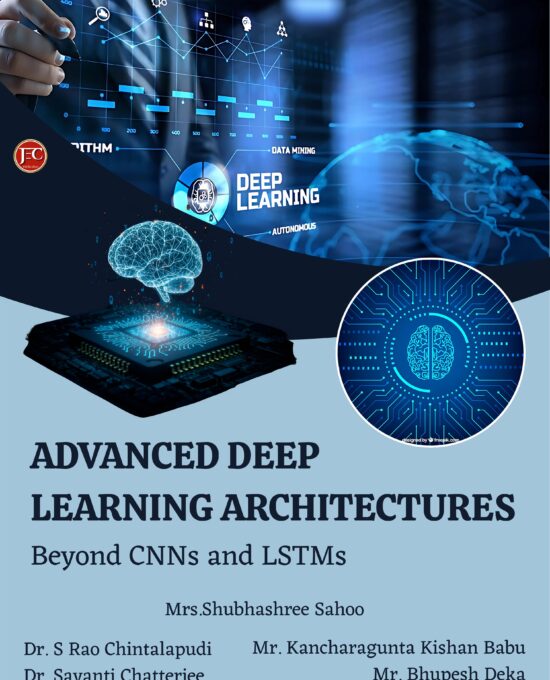
ADVANCED DEEP LEARNING ARCHITECTURES Beyond CNNs and LSTMs
₹499.00
Deep learning has fundamentally transformed the landscape of artificial intelligence, powering
breakthroughs in computer vision, natural language processing, speech recognition, and beyond.
Over the past decade, Convolutional Neural Networks (CNNs) and Long Short-Term Memory
networks (LSTMs) emerged as the dominant architectures for tackling structured image data and
sequential information, respectively. CNNs, with their hierarchical feature extraction and local
receptive fields, revolutionized image classification, object detection, and semantic segmentation,
enabling systems to achieve near-human or even superhuman performance on benchmarks such
as ImageNet. LSTMs, on the other hand, overcame the limitations of traditional recurrent neural
networks, effectively addressing the vanishing gradient problem and enabling long-range
temporal dependencies to be learned, thereby advancing language modeling, machine translation,
and speech synthesis.
However, as datasets expanded to billions of samples, tasks grew increasingly complex, and the
need for generalization across heterogeneous domains intensified, the inherent limitations of
CNNs and LSTMs became apparent. CNNs struggle with modeling long-range dependencies,
processing irregular graph-structured data, or integrating multimodal inputs, while LSTMs face
challenges in parallelization, handling very long sequences efficiently, and scaling to massive
model sizes. Moreover, simply increasing depth, width, or training data does not always guarantee
proportional improvements in performance, highlighting the plateauing effect of these
architectures in cutting-edge AI applications.
This book, Advanced Deep Learning Architectures: Beyond CNNs and LSTMs, is designed to chart
the evolution of next-generation architectures that address these limitations and define the future
of artificial intelligence. It offers a comprehensive journey through the design principles,
mathematical foundations, and practical implementations of state-of-the-art models. The scope
spans transformers — including BERT, GPT, and Vision Transformers — which leverage selfattention to model long-range dependencies and multimodal relationships; graph neural networks,
which enable AI systems to reason about relational and non-Euclidean data; capsule networks,
which improve spatial hierarchies and pose awareness; neural ordinary differential equations,
which introduce continuous-time modeling; and diffusion models, which have redefined
generative AI through probabilistic modeling and denoising frameworks. The book also delves
into hybrid and multimodal architectures, advanced reinforcement learning frameworks, and
emerging paradigms such as neuromorphic computing, quantum deep learning, and evolutionary algorithms. Importantly, the text bridges theory and practice. Each chapter combines rigorous
mathematical derivations — from linear algebra and tensor calculus to probabilistic modeling and
information-theoretic analysis — with hands-on Python implementations using libraries such as
PyTorch, TensorFlow, and NumPy. Readers are guided through step-by-step coding exercises,
practical tips for optimization, and demonstrations of applying these models to real-world datasets.
This dual approach ensures a deep understanding not just of why these architectures work, but
how to implement, experiment, and extend them.
Beyond technical mastery, the book emphasizes the broader implications of advanced AI:
multimodal intelligence, ethical alignment, interpretability, and the path toward general-purpose
AI systems.
ADVANCED DEEP LEARNING ARCHITECTURES Beyond CNNs and LSTMs
₹499.00
Deep learning has fundamentally transformed the landscape of artificial intelligence, powering
breakthroughs in computer vision, natural language processing, speech recognition, and beyond.
Over the past decade, Convolutional Neural Networks (CNNs) and Long Short-Term Memory
networks (LSTMs) emerged as the dominant architectures for tackling structured image data and
sequential information, respectively. CNNs, with their hierarchical feature extraction and local
receptive fields, revolutionized image classification, object detection, and semantic segmentation,
enabling systems to achieve near-human or even superhuman performance on benchmarks such
as ImageNet. LSTMs, on the other hand, overcame the limitations of traditional recurrent neural
networks, effectively addressing the vanishing gradient problem and enabling long-range
temporal dependencies to be learned, thereby advancing language modeling, machine translation,
and speech synthesis.
However, as datasets expanded to billions of samples, tasks grew increasingly complex, and the
need for generalization across heterogeneous domains intensified, the inherent limitations of
CNNs and LSTMs became apparent. CNNs struggle with modeling long-range dependencies,
processing irregular graph-structured data, or integrating multimodal inputs, while LSTMs face
challenges in parallelization, handling very long sequences efficiently, and scaling to massive
model sizes. Moreover, simply increasing depth, width, or training data does not always guarantee
proportional improvements in performance, highlighting the plateauing effect of these
architectures in cutting-edge AI applications.
This book, Advanced Deep Learning Architectures: Beyond CNNs and LSTMs, is designed to chart
the evolution of next-generation architectures that address these limitations and define the future
of artificial intelligence. It offers a comprehensive journey through the design principles,
mathematical foundations, and practical implementations of state-of-the-art models. The scope
spans transformers — including BERT, GPT, and Vision Transformers — which leverage selfattention to model long-range dependencies and multimodal relationships; graph neural networks,
which enable AI systems to reason about relational and non-Euclidean data; capsule networks,
which improve spatial hierarchies and pose awareness; neural ordinary differential equations,
which introduce continuous-time modeling; and diffusion models, which have redefined
generative AI through probabilistic modeling and denoising frameworks. The book also delves
into hybrid and multimodal architectures, advanced reinforcement learning frameworks, and
emerging paradigms such as neuromorphic computing, quantum deep learning, and evolutionary algorithms. Importantly, the text bridges theory and practice. Each chapter combines rigorous
mathematical derivations — from linear algebra and tensor calculus to probabilistic modeling and
information-theoretic analysis — with hands-on Python implementations using libraries such as
PyTorch, TensorFlow, and NumPy. Readers are guided through step-by-step coding exercises,
practical tips for optimization, and demonstrations of applying these models to real-world datasets.
This dual approach ensures a deep understanding not just of why these architectures work, but
how to implement, experiment, and extend them.
Beyond technical mastery, the book emphasizes the broader implications of advanced AI:
multimodal intelligence, ethical alignment, interpretability, and the path toward general-purpose
AI systems.

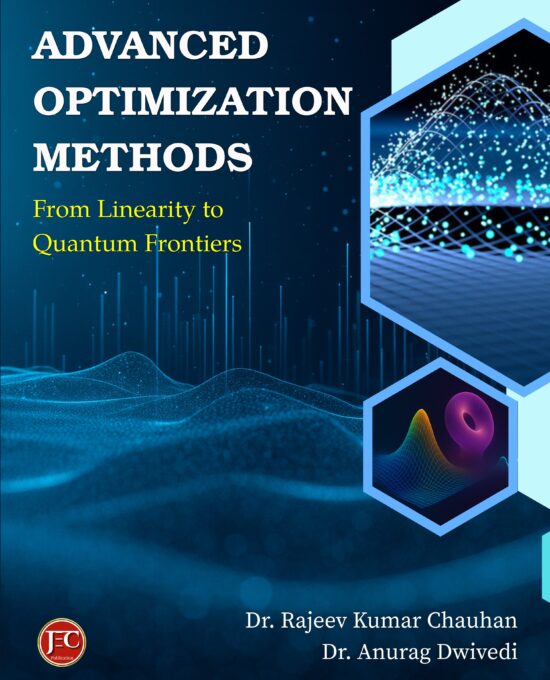
Advanced Optimization Methods From Linearity To Quantum Frontiers
₹499.00
Optimization lies at the core of modern science, engineering, and decision-making, providing
systematic methods to identify the best possible solutions under given constraints. This book presents
a comprehensive and integrated treatment of optimization, beginning with foundational concepts and
mathematical prerequisites and progressing through linear, nonlinear, combinatorial, dynamic,
stochastic, and convex optimization frameworks. Emphasis is placed on both theoretical
understanding and algorithmic implementation, ensuring that readers not only grasp underlying
principles but also learn how to apply them to real-world problems. Historical developments are
interwoven with contemporary methods to highlight the evolution of optimization as a discipline.
Each chapter is structured to balance rigor with intuition, supported by classical examples,
algorithms, and practical applications across engineering, economics, artificial intelligence, and the
natural sciences. Designed for students, researchers, and practitioners, this book aims to build strong
conceptual foundations while also introducing advanced topics and emerging frontiers. Ultimately, it
seeks to cultivate analytical thinking and equip readers with versatile optimization tools for solving
complex, real-world challenges.
Advanced Optimization Methods From Linearity To Quantum Frontiers
₹499.00
Optimization lies at the core of modern science, engineering, and decision-making, providing
systematic methods to identify the best possible solutions under given constraints. This book presents
a comprehensive and integrated treatment of optimization, beginning with foundational concepts and
mathematical prerequisites and progressing through linear, nonlinear, combinatorial, dynamic,
stochastic, and convex optimization frameworks. Emphasis is placed on both theoretical
understanding and algorithmic implementation, ensuring that readers not only grasp underlying
principles but also learn how to apply them to real-world problems. Historical developments are
interwoven with contemporary methods to highlight the evolution of optimization as a discipline.
Each chapter is structured to balance rigor with intuition, supported by classical examples,
algorithms, and practical applications across engineering, economics, artificial intelligence, and the
natural sciences. Designed for students, researchers, and practitioners, this book aims to build strong
conceptual foundations while also introducing advanced topics and emerging frontiers. Ultimately, it
seeks to cultivate analytical thinking and equip readers with versatile optimization tools for solving
complex, real-world challenges.