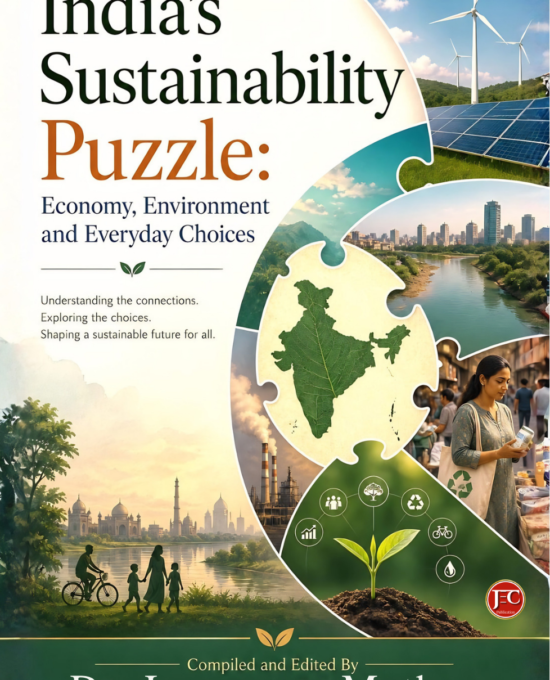
India’s Sustainability Puzzle: Economy, Environment and Everyday Choices.
India’s Sustainability Puzzle: Economy, Environment and Everyday Choices, edited by Dr. Lawrence Mathew, brings together diverse perspectives on sustainability in the Indian context. The book explores sustainability not merely as an environmental concern, but as an interconnected economic, social, institutional, technological, and behavioural challenge.
Through twelve chapters, the book examines subjects including circular economy and waste-to-infrastructure models, wetland microbiomes, sustainable agriculture and microbial approaches, menstrual health, rural entrepreneurship, gender equality and public policy, socially responsible behaviour, mangrove conservation, women's WASH challenges, and eco-tourism.
Drawing on research, case studies, policy perspectives, and practical approaches, the volume highlights how environmental protection, economic development, social inclusion, responsible consumption, and everyday choices are closely connected. It encourages readers to view sustainability as a shared responsibility and to think critically about how individual and institutional actions can contribute to a more resilient and sustainable India.


INDIAN KNOWLEDGE SYSTEMS PERSPECTIVES AND PRACTICES
INDIAN KNOWLEDGE SYSTEMS PERSPECTIVES AND PRACTICES





Industrial Pharmacy – II
Industrial Pharmacy – II


Ingredients For Love
Ingredients For Love


Inner Treasure
Inner Treasure



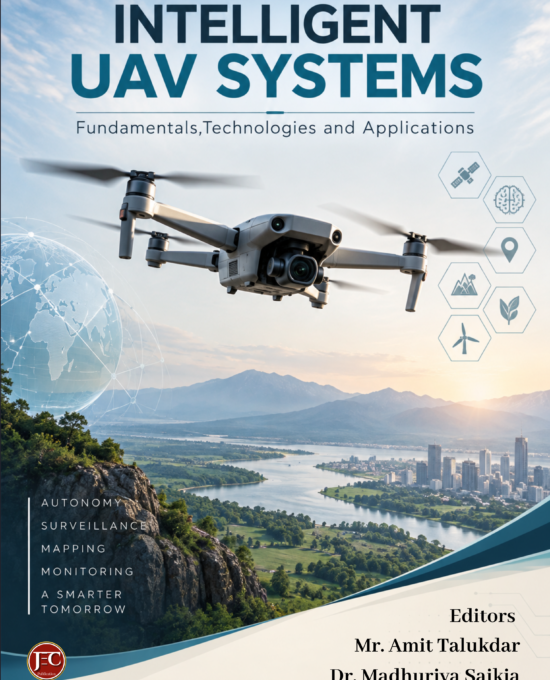
Intelligent UAV Systems: Fundamentals, Technologies And Applications
With the fast pace in which Unmanned Aerial Vehicles (UAVs), popularly known as drones, have been developing, several breakthroughs have been achieved in numerous sectors like surveillance, inspections, security, agriculture, and disaster relief operations. In this project book, an insight into drone technology is provided, covering topics related to the introduction, mechanisms, and types of drones depending on their structure and application. Specifically, the main focus of the book is on crack detection drones, whose application involves inspecting infrastructural assets like buildings, bridges, and structures for any possible damage by utilizing camera sensors. Another type of drone covered in the book is Visual Inertial Odometry (VIO) drones, whose principle of operation allows for smooth and uninterrupted navigation without the need for GPS signals, which are usually integrated with vision and inertial sensors. Furthermore, there is coverage of ant drones, which operate by detecting and preventing unauthorized drone activities using technologies such as radar, RF detection, and jamming systems.