Mastering Data Structures Foundations, Implementation, And Applications
₹499.00
Data Structures form the backbone of computer science and software engineering, providing the
fundamental mechanisms for organizing, managing, and processing data efficiently. A strong
understanding of data structures is essential not only for academic excellence but also for solving realworld computational problems and designing scalable, high-performance systems.
This book, Mastering Data Structures: Foundations, Implementation, and Applications, is written with
the objective of offering a comprehensive, structured, and application-oriented treatment of data
structures. It is designed to bridge the gap between theoretical concepts and practical implementation,
enabling learners to develop both conceptual clarity and problem-solving proficiency.
The content of this book progresses systematically from basic linear data structures such as arrays, stacks,
queues, and linked lists to more advanced non-linear structures including trees, graphs, heaps, and hashing
techniques. Each topic is presented with clear explanations, illustrative examples, and well-structured
algorithms to facilitate ease of understanding. Emphasis has been placed on time and space complexity
analysis to help readers evaluate the efficiency of various approaches.
In addition to core concepts, this book integrates practical programming perspectives, primarily using
Python, to demonstrate real-world applicability. Numerous examples, exercises, and case studies are
included to reinforce learning and encourage hands-on experimentation. A dedicated section on capstone
projects has been incorporated to guide students in applying data structure concepts to realistic problem
scenarios, thereby fostering analytical thinking and design skills.
This book is intended for undergraduate and postgraduate students of Computer Science, Information
Technology, and related disciplines. It will also serve as a useful reference for educators, competitive
programming aspirants, and professionals seeking to strengthen their foundational knowledge of data
structures.
The author sincerely hopes that this book will serve as a valuable learning resource, helping readers
develop a strong and enduring understanding of data structures and their applications. Constructive
feedback and suggestions from readers are warmly welcomed for the improvement of future editions.
Mastering Data Structures Foundations, Implementation, And Applications
₹499.00
Data Structures form the backbone of computer science and software engineering, providing the
fundamental mechanisms for organizing, managing, and processing data efficiently. A strong
understanding of data structures is essential not only for academic excellence but also for solving realworld computational problems and designing scalable, high-performance systems.
This book, Mastering Data Structures: Foundations, Implementation, and Applications, is written with
the objective of offering a comprehensive, structured, and application-oriented treatment of data
structures. It is designed to bridge the gap between theoretical concepts and practical implementation,
enabling learners to develop both conceptual clarity and problem-solving proficiency.
The content of this book progresses systematically from basic linear data structures such as arrays, stacks,
queues, and linked lists to more advanced non-linear structures including trees, graphs, heaps, and hashing
techniques. Each topic is presented with clear explanations, illustrative examples, and well-structured
algorithms to facilitate ease of understanding. Emphasis has been placed on time and space complexity
analysis to help readers evaluate the efficiency of various approaches.
In addition to core concepts, this book integrates practical programming perspectives, primarily using
Python, to demonstrate real-world applicability. Numerous examples, exercises, and case studies are
included to reinforce learning and encourage hands-on experimentation. A dedicated section on capstone
projects has been incorporated to guide students in applying data structure concepts to realistic problem
scenarios, thereby fostering analytical thinking and design skills.
This book is intended for undergraduate and postgraduate students of Computer Science, Information
Technology, and related disciplines. It will also serve as a useful reference for educators, competitive
programming aspirants, and professionals seeking to strengthen their foundational knowledge of data
structures.
The author sincerely hopes that this book will serve as a valuable learning resource, helping readers
develop a strong and enduring understanding of data structures and their applications. Constructive
feedback and suggestions from readers are warmly welcomed for the improvement of future editions.
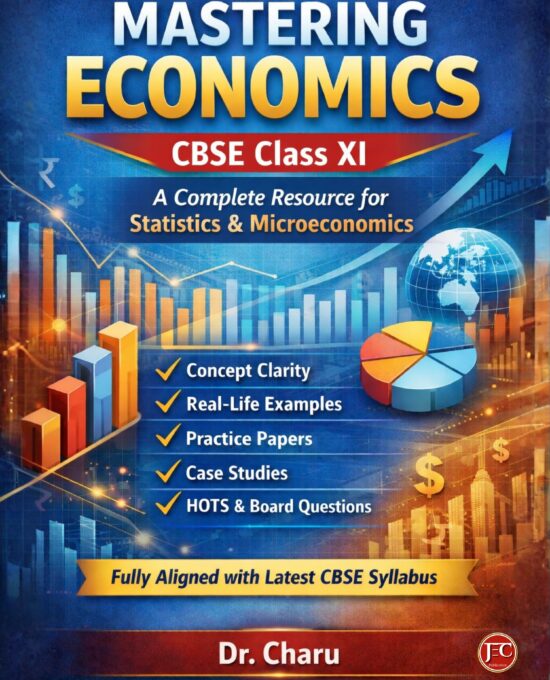
MASTERING ECONOMICS
₹499.00
Economics, as a social science, depends significantly on theoretical reasoning and quantitative
analysis to comprehend and elucidate the intricate issues surrounding the production, distribution,
and use of resources. Statistics for Economics and Introductory Microeconomics together
establish a core framework for students to systematically and rationally evaluate economic
phenomena. Statistics for Economics provides learners with fundamental tools for data collection,
categorization, tabulation, and interpretation, allowing for precise measurement of economic
variables such as income, prices, employment, and growth. Utilizing statistical techniques such as
averages, dispersion, correlation, and index numbers, students acquire the capability to convert
raw data into significant information for economic decision-making and policy development.
Simultaneously, Introductory to Microeconomics familiarizes students with the essential concepts
regulating individual economic entities, including consumers, businesses, and markets. It
elucidates the interaction between demand and supply in price determination, the pursuit of
maximum consumer happiness within the constraints of limited income, and the objective of
producers to attain efficiency and profit amidst scarcity. Through the integration of
microeconomic theory and statistical analysis, students cultivate a comprehensive grasp of both
theoretical and empirical methodologies in economics. These disciplines together promote
analytical reasoning, problem-solving capabilities, and the pragmatic application of economic
principles in real-world contexts, including market dynamics, resource distribution, and public
policy assessment. This course establishes a robust intellectual basis for advanced study in
economics and related fields, while cultivating the analytical and critical thinking skills necessary
for comprehending contemporary economic systems.
MASTERING ECONOMICS
₹499.00
Economics, as a social science, depends significantly on theoretical reasoning and quantitative
analysis to comprehend and elucidate the intricate issues surrounding the production, distribution,
and use of resources. Statistics for Economics and Introductory Microeconomics together
establish a core framework for students to systematically and rationally evaluate economic
phenomena. Statistics for Economics provides learners with fundamental tools for data collection,
categorization, tabulation, and interpretation, allowing for precise measurement of economic
variables such as income, prices, employment, and growth. Utilizing statistical techniques such as
averages, dispersion, correlation, and index numbers, students acquire the capability to convert
raw data into significant information for economic decision-making and policy development.
Simultaneously, Introductory to Microeconomics familiarizes students with the essential concepts
regulating individual economic entities, including consumers, businesses, and markets. It
elucidates the interaction between demand and supply in price determination, the pursuit of
maximum consumer happiness within the constraints of limited income, and the objective of
producers to attain efficiency and profit amidst scarcity. Through the integration of
microeconomic theory and statistical analysis, students cultivate a comprehensive grasp of both
theoretical and empirical methodologies in economics. These disciplines together promote
analytical reasoning, problem-solving capabilities, and the pragmatic application of economic
principles in real-world contexts, including market dynamics, resource distribution, and public
policy assessment. This course establishes a robust intellectual basis for advanced study in
economics and related fields, while cultivating the analytical and critical thinking skills necessary
for comprehending contemporary economic systems.