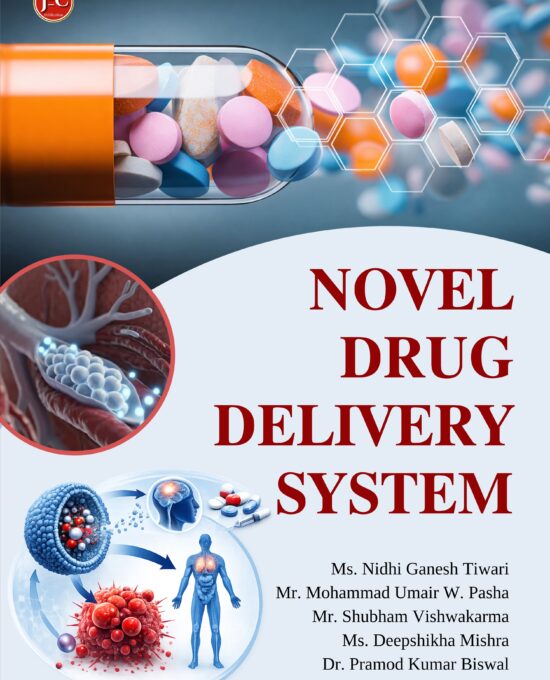
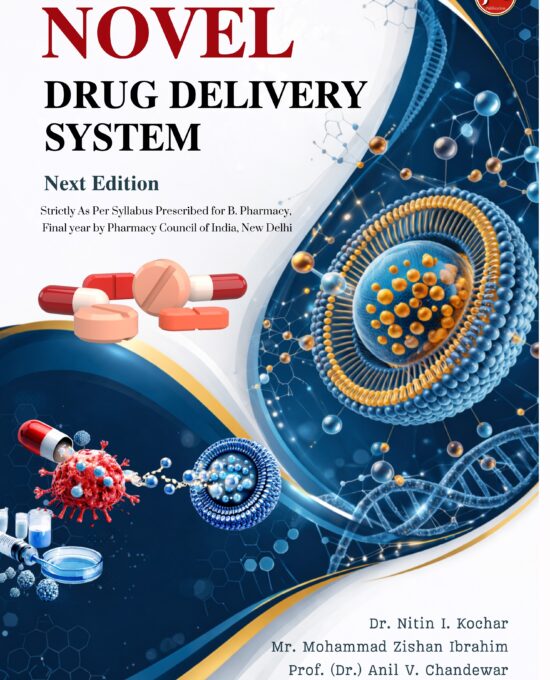
NOVEL DRUG DELIVERY SYSTEM
₹499.00
Welcome to "Novel Drug Delivery Systems," a comprehensive textbook tailored for B Pharmacy
final year students. This book is designed to provide you with a thorough understanding of the
advanced concepts and technologies in drug delivery systems that are essential for modern
pharmaceutical practice.
In recent years, significant advancements have been made in the field of drug delivery, driven by the
need for improved therapeutic efficacy, reduced side effects, and enhanced patient compliance. This
book delves into several crucial topics that form the backbone of these innovations.
The journey through this textbook begins with an exploration of Controlled Drug Delivery Systems,
where you will learn about various mechanisms to control the release rate and spatial distribution of
drugs within the body. Understanding these systems is crucial for optimizing drug therapy outcomes
and achieving targeted effects. Polymers play a pivotal role in the design and development of drug
delivery systems. A dedicated chapter discusses their properties, types, and applications in
formulating controlled and targeted drug delivery systems. This knowledge is fundamental for
manipulating drug release kinetics and ensuring stability and biocompatibility.Microencapsulation
has emerged as a powerful technique in pharmaceutical sciences, allowing for the encapsulation of
drugs within microspheres or microcapsules. This approach enhances drug stability, prolongs release,
and facilitates targeted delivery, which are thoroughly covered in this book. Implantable Drug
Delivery Systems represent another frontier in pharmaceutical technology, offering sustained release
of therapeutics over extended periods. The mechanisms, materials, and applications of these systems
are elucidated, providing insights into their clinical significance and practical implementation.
Furthermore, this book explores other contemporary topics such as Nanotechnology in Drug
Delivery, Lipid-based Delivery Systems, and Transdermal Drug Delivery, reflecting the diverse
strategies employed to overcome biological barriers and optimize therapeutic outcomes.
Each chapter is meticulously crafted to provide you with a blend of theoretical insights and practical
applications, supported by illustrative figures, case studies, and recent research findings. We aim to
equip you with the knowledge and skills necessary to critically evaluate, design, and develop novel
drug delivery systems that meet current healthcare challenges.
NOVEL DRUG DELIVERY SYSTEM
₹499.00
Welcome to "Novel Drug Delivery Systems," a comprehensive textbook tailored for B Pharmacy
final year students. This book is designed to provide you with a thorough understanding of the
advanced concepts and technologies in drug delivery systems that are essential for modern
pharmaceutical practice.
In recent years, significant advancements have been made in the field of drug delivery, driven by the
need for improved therapeutic efficacy, reduced side effects, and enhanced patient compliance. This
book delves into several crucial topics that form the backbone of these innovations.
The journey through this textbook begins with an exploration of Controlled Drug Delivery Systems,
where you will learn about various mechanisms to control the release rate and spatial distribution of
drugs within the body. Understanding these systems is crucial for optimizing drug therapy outcomes
and achieving targeted effects. Polymers play a pivotal role in the design and development of drug
delivery systems. A dedicated chapter discusses their properties, types, and applications in
formulating controlled and targeted drug delivery systems. This knowledge is fundamental for
manipulating drug release kinetics and ensuring stability and biocompatibility.Microencapsulation
has emerged as a powerful technique in pharmaceutical sciences, allowing for the encapsulation of
drugs within microspheres or microcapsules. This approach enhances drug stability, prolongs release,
and facilitates targeted delivery, which are thoroughly covered in this book. Implantable Drug
Delivery Systems represent another frontier in pharmaceutical technology, offering sustained release
of therapeutics over extended periods. The mechanisms, materials, and applications of these systems
are elucidated, providing insights into their clinical significance and practical implementation.
Furthermore, this book explores other contemporary topics such as Nanotechnology in Drug
Delivery, Lipid-based Delivery Systems, and Transdermal Drug Delivery, reflecting the diverse
strategies employed to overcome biological barriers and optimize therapeutic outcomes.
Each chapter is meticulously crafted to provide you with a blend of theoretical insights and practical
applications, supported by illustrative figures, case studies, and recent research findings. We aim to
equip you with the knowledge and skills necessary to critically evaluate, design, and develop novel
drug delivery systems that meet current healthcare challenges.