


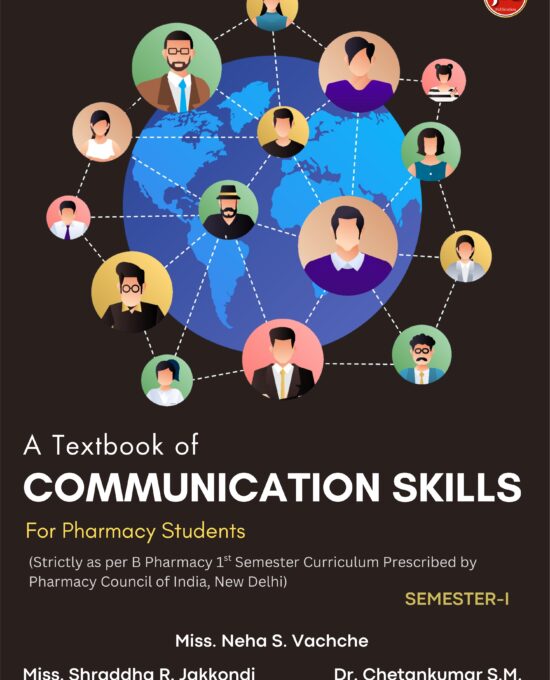
A Textbook of COMMUNICATION SKILLS
₹499.00
A Textbook of Communication Skills for Pharmacy Students is designed to meet
the specific needs of budding pharmacists by equipping them with essential soft skills
required in professional healthcare settings. Communication is the foundation of
effective pharmacy practice, as pharmacists routinely interact with doctors, nurses,
dentists, physiotherapists, patients, and other healthcare professionals. This book
provides a clear, structured approach to developing the ability to convey information
confidently, accurately, and empathetically.
The content is carefully aligned with the Pharmacy Council of India’s BP105T
Communication Skills (Theory) syllabus, ensuring that students acquire not only
theoretical knowledge but also practical competence. Each unit systematically
introduces learners to the fundamentals of communication-covering verbal, nonverbal, and written communication-while also addressing barriers that may hinder
effective interactions.
Students will explore diverse aspects such as communication processes, listening
skills, and communication styles, alongside practical skills like interview techniques,
presentations, and group discussions. The book emphasizes both professional and
interpersonal dimensions, preparing students to become effective team players and
leaders in the pharmaceutical sector.
In addition, the text highlights the behavioural and attitudinal requirements of a
pharmacist, focusing on teamwork, leadership, empathy, and patient-centered
communication. Examples, illustrations, and simplified explanations make the
content easy to understand, while the inclusion of real-life applications encourages
students to practice and refine their skills.
Overall, this book aims to bridge the gap between knowledge and practice, helping
pharmacy students develop confidence, clarity, and professionalism in their
communication. By mastering these skills early in their academic journey, students
will be better prepared to contribute meaningfully to patient care, collaborative
healthcare teams, and the pharmaceutical business environment.
A Textbook of COMMUNICATION SKILLS
₹499.00
A Textbook of Communication Skills for Pharmacy Students is designed to meet
the specific needs of budding pharmacists by equipping them with essential soft skills
required in professional healthcare settings. Communication is the foundation of
effective pharmacy practice, as pharmacists routinely interact with doctors, nurses,
dentists, physiotherapists, patients, and other healthcare professionals. This book
provides a clear, structured approach to developing the ability to convey information
confidently, accurately, and empathetically.
The content is carefully aligned with the Pharmacy Council of India’s BP105T
Communication Skills (Theory) syllabus, ensuring that students acquire not only
theoretical knowledge but also practical competence. Each unit systematically
introduces learners to the fundamentals of communication-covering verbal, nonverbal, and written communication-while also addressing barriers that may hinder
effective interactions.
Students will explore diverse aspects such as communication processes, listening
skills, and communication styles, alongside practical skills like interview techniques,
presentations, and group discussions. The book emphasizes both professional and
interpersonal dimensions, preparing students to become effective team players and
leaders in the pharmaceutical sector.
In addition, the text highlights the behavioural and attitudinal requirements of a
pharmacist, focusing on teamwork, leadership, empathy, and patient-centered
communication. Examples, illustrations, and simplified explanations make the
content easy to understand, while the inclusion of real-life applications encourages
students to practice and refine their skills.
Overall, this book aims to bridge the gap between knowledge and practice, helping
pharmacy students develop confidence, clarity, and professionalism in their
communication. By mastering these skills early in their academic journey, students
will be better prepared to contribute meaningfully to patient care, collaborative
healthcare teams, and the pharmaceutical business environment.



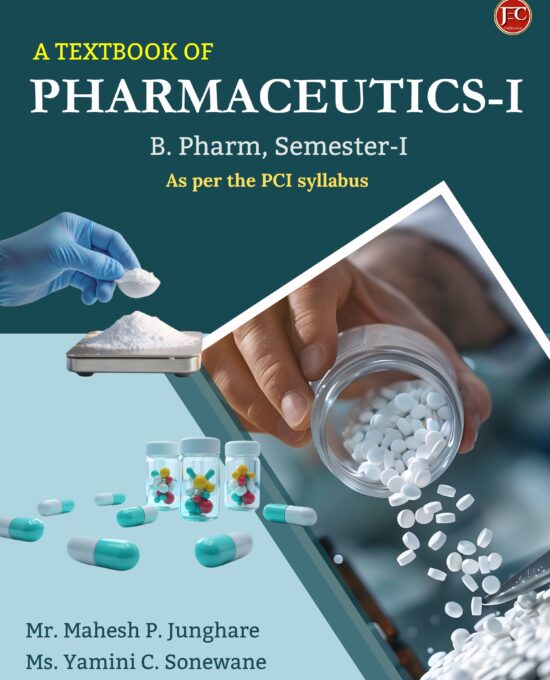
A textbook of Pharmaceutics-I
₹499.00
The discipline of pharmaceutics serves as a vital bridge between drug discovery and the large-scale
production of medications that adhere to regulatory, safety, and efficacy standards. As the pharmaceutical
sciences continue to advance, it is crucial for students to build a solid understanding of the principles,
processes, and practices that underpin the industrial manufacturing of pharmaceutical products.
This textbook on Pharmaceutics is specifically crafted for first-semester B. Pharm students. It offers a
thorough exploration of industrial pharmacy, covering key topics such as formulation development,
quality control, manufacturing processes, regulatory compliance, and the principles of Good
Manufacturing Practices (GMP). The book aims to provide students with both foundational theoretical
knowledge and practical insights essential for navigating the complexities of pharmaceutical production.
Each chapter has been meticulously organized to ensure clarity and comprehension, incorporating
detailed explanations, illustrative diagrams, and real-world examples to enhance the learning experience.
Special attention has been given to industry-relevant subjects to foster critical thinking and problemsolving skills, which are indispensable in today’s rapidly evolving pharmaceutical sector.
Additionally, the textbook addresses significant emerging trends in pharmaceutical manufacturing, such
as advancements in automation, biotechnology, and regulatory affairs. This forward-looking approach
prepares students to tackle future challenges in the field. By bridging academic concepts with practical
applications, the book aligns with the demands of the professional world, making it a valuable resource
for aspiring industrial pharmacy professionals.
It is my hope that this textbook will serve as an indispensable guide, equipping students with the
knowledge and skills necessary to excel in both their academic journey and their professional careers in
industrial pharmacy.
Mr. Mahesh P. Junghare
(M. Pharm. – Pharmacognosy)
Ms. Yamini C. Sonewane
(Bachelor of Pharmacy)
A textbook of Pharmaceutics-I
₹499.00
The discipline of pharmaceutics serves as a vital bridge between drug discovery and the large-scale
production of medications that adhere to regulatory, safety, and efficacy standards. As the pharmaceutical
sciences continue to advance, it is crucial for students to build a solid understanding of the principles,
processes, and practices that underpin the industrial manufacturing of pharmaceutical products.
This textbook on Pharmaceutics is specifically crafted for first-semester B. Pharm students. It offers a
thorough exploration of industrial pharmacy, covering key topics such as formulation development,
quality control, manufacturing processes, regulatory compliance, and the principles of Good
Manufacturing Practices (GMP). The book aims to provide students with both foundational theoretical
knowledge and practical insights essential for navigating the complexities of pharmaceutical production.
Each chapter has been meticulously organized to ensure clarity and comprehension, incorporating
detailed explanations, illustrative diagrams, and real-world examples to enhance the learning experience.
Special attention has been given to industry-relevant subjects to foster critical thinking and problemsolving skills, which are indispensable in today’s rapidly evolving pharmaceutical sector.
Additionally, the textbook addresses significant emerging trends in pharmaceutical manufacturing, such
as advancements in automation, biotechnology, and regulatory affairs. This forward-looking approach
prepares students to tackle future challenges in the field. By bridging academic concepts with practical
applications, the book aligns with the demands of the professional world, making it a valuable resource
for aspiring industrial pharmacy professionals.
It is my hope that this textbook will serve as an indispensable guide, equipping students with the
knowledge and skills necessary to excel in both their academic journey and their professional careers in
industrial pharmacy.
Mr. Mahesh P. Junghare
(M. Pharm. – Pharmacognosy)
Ms. Yamini C. Sonewane
(Bachelor of Pharmacy)