
Elegant Deception & White – Collar War In The Corporate Jungle
₹499.00
Personality is something that increases an individual's value and outlook. The term "personality"
refers to the quality traits, interests, attributes, values, ethics, self-concept, abilities, aptitude,
confident and emotional balanced that make up a person's particular way of reflecting their life in
the society.
According to social cognitive theory, people create their personalities as they observe how others
behave.
OBSERVATION > CONVERSATION
Assimilation and adaption result from this, especially if individual’s observation and awareness
zone is magnificently masterly.
These are four categories of personalities: Dominance, Steadiness, Influence, and
Conscientiousness.
A person's personality falls into one of these types from the expression of their dominant personality
characteristic. Personality is not limited to only physical presence and impression but it is clubbed
with many other attributes namely psychological, spiritual, social, emotional, knowledge and
attitude aspects. Person should be capable to self-evaluate once reaction, performance and actual
outcomes on particular situation. This is possible only if individual holds good analyzing skills.
This analyzing skill is one of major part of personality development or grooming session. If one
has good analyzing skills, they can easily observe the shortcomings they have in their performance
and upgrade their performance level accordingly. It is a big question for all, how to build
confidence, how to speak in public, how to be impressive in their personal and professional life’s.
Many students now days don’t know which approach to adapt to have remarkable personality. They
think learning English can sort their problem and they could fit the situation. But actually, the major
issue is that they need to understand that speaking English and personality are two different things.
Learning to speak English is just an addition and augmentation to once profile, but not actual hero
in framing the whole personality. Framing personality can be started with, first learning to observe
the situation. And before observing, one must activate their workplace's zone of awareness. The
dynamic manufacturing and refining of integrative characteristics that identify an individual in
terms of remarkable employability skills is referred to as personality development. Personality
development is a phenomenal process that is influenced by many factors and raw life experiences
that all together design an individual to represent themselves in the external environment.
Elegant Deception & White – Collar War In The Corporate Jungle
₹499.00
Personality is something that increases an individual's value and outlook. The term "personality"
refers to the quality traits, interests, attributes, values, ethics, self-concept, abilities, aptitude,
confident and emotional balanced that make up a person's particular way of reflecting their life in
the society.
According to social cognitive theory, people create their personalities as they observe how others
behave.
OBSERVATION > CONVERSATION
Assimilation and adaption result from this, especially if individual’s observation and awareness
zone is magnificently masterly.
These are four categories of personalities: Dominance, Steadiness, Influence, and
Conscientiousness.
A person's personality falls into one of these types from the expression of their dominant personality
characteristic. Personality is not limited to only physical presence and impression but it is clubbed
with many other attributes namely psychological, spiritual, social, emotional, knowledge and
attitude aspects. Person should be capable to self-evaluate once reaction, performance and actual
outcomes on particular situation. This is possible only if individual holds good analyzing skills.
This analyzing skill is one of major part of personality development or grooming session. If one
has good analyzing skills, they can easily observe the shortcomings they have in their performance
and upgrade their performance level accordingly. It is a big question for all, how to build
confidence, how to speak in public, how to be impressive in their personal and professional life’s.
Many students now days don’t know which approach to adapt to have remarkable personality. They
think learning English can sort their problem and they could fit the situation. But actually, the major
issue is that they need to understand that speaking English and personality are two different things.
Learning to speak English is just an addition and augmentation to once profile, but not actual hero
in framing the whole personality. Framing personality can be started with, first learning to observe
the situation. And before observing, one must activate their workplace's zone of awareness. The
dynamic manufacturing and refining of integrative characteristics that identify an individual in
terms of remarkable employability skills is referred to as personality development. Personality
development is a phenomenal process that is influenced by many factors and raw life experiences
that all together design an individual to represent themselves in the external environment.
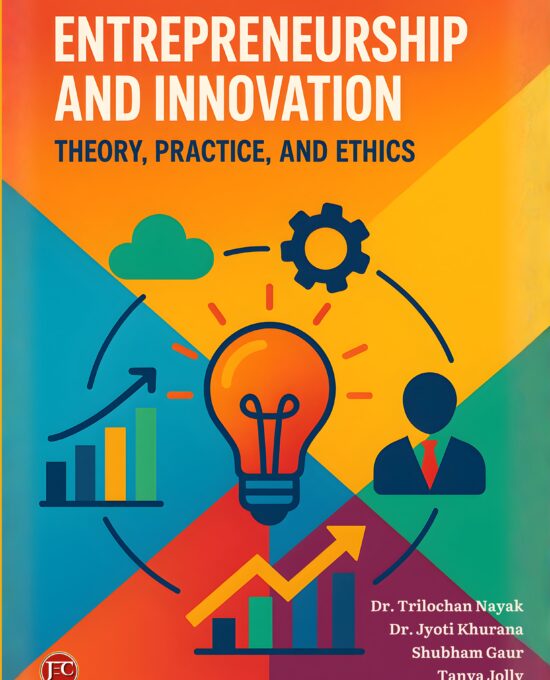
ENTREPRENEURSHIP AND INNOVATION THEORY, PRACTICE, AND ETHICS
₹499.00
Entrepreneurship and innovation have emerged as defining forces of the twenty-first-century global
economy. In an era characterized by rapid technological disruptions, shifting consumer expectations,
and the continual reconfiguration of markets, understanding these forces is no longer optional—it is
essential. This book has been conceived as a comprehensive, conceptually rigorous, and pedagogically
grounded text to support learners, educators, and practitioners in navigating the evolving landscape of
entrepreneurial thought and practice.
The chapters in this volume span the foundational to the frontier. Beginning with the conceptual roots
of entrepreneurship and innovation, the book progressively unfolds into sophisticated theories, models,
and real-world applications that shape contemporary entrepreneurial ecosystems. The content traverses
classical, neo-classical, and modern economic perspectives; Schumpeterian innovation dynamics;
effectuation and Lean Startup approaches; and emerging paradigms of digital transformation,
sustainability, and social entrepreneurship. Each unit has been carefully structured to provide clarity,
contextual depth, and analytical precision, supported by learning objectives, outcomes, and reflective
exercises that strengthen comprehension and application.
This text is deeply informed by the collective academic experience, research engagement, and industry
exposure of its authors. Drawing on interdisciplinary insights and empirical realities, it places equal
emphasis on theory and practice, ensuring that readers not only understand the evolution of
entrepreneurial ideas but also gain the analytical tools to apply them in diverse environments. Our
intention is to facilitate a holistic understanding—one that equips students to become opportunityseekers, innovators, problem-solvers, and ethically responsible leaders.
We hope that this book serves as a valuable companion for undergraduate and postgraduate learners of
management, commerce, and allied disciplines; for educators designing curricula and teaching
entrepreneurship; and for aspiring entrepreneurs who seek structured guidance in their journey from
idea to enterprise. The rapidly changing entrepreneurial landscape demands continuous learning,
adaptability, and critical thinking—qualities that this text endeavours to cultivate.
We express our sincere gratitude to JEC Publication for their support in bringing this work to life, and
to all scholars, students, and professionals whose insights continue to enrich the field of
entrepreneurship studies. It is our earnest belief that this book will inspire readers to reflect, explore,
innovate, and contribute meaningfully to society through entrepreneurial action.
Dr. Trilochan Nayak
Dr. Jyoti Khurana
Shubham Gaur
Tanya Jolly
ENTREPRENEURSHIP AND INNOVATION THEORY, PRACTICE, AND ETHICS
₹499.00
Entrepreneurship and innovation have emerged as defining forces of the twenty-first-century global
economy. In an era characterized by rapid technological disruptions, shifting consumer expectations,
and the continual reconfiguration of markets, understanding these forces is no longer optional—it is
essential. This book has been conceived as a comprehensive, conceptually rigorous, and pedagogically
grounded text to support learners, educators, and practitioners in navigating the evolving landscape of
entrepreneurial thought and practice.
The chapters in this volume span the foundational to the frontier. Beginning with the conceptual roots
of entrepreneurship and innovation, the book progressively unfolds into sophisticated theories, models,
and real-world applications that shape contemporary entrepreneurial ecosystems. The content traverses
classical, neo-classical, and modern economic perspectives; Schumpeterian innovation dynamics;
effectuation and Lean Startup approaches; and emerging paradigms of digital transformation,
sustainability, and social entrepreneurship. Each unit has been carefully structured to provide clarity,
contextual depth, and analytical precision, supported by learning objectives, outcomes, and reflective
exercises that strengthen comprehension and application.
This text is deeply informed by the collective academic experience, research engagement, and industry
exposure of its authors. Drawing on interdisciplinary insights and empirical realities, it places equal
emphasis on theory and practice, ensuring that readers not only understand the evolution of
entrepreneurial ideas but also gain the analytical tools to apply them in diverse environments. Our
intention is to facilitate a holistic understanding—one that equips students to become opportunityseekers, innovators, problem-solvers, and ethically responsible leaders.
We hope that this book serves as a valuable companion for undergraduate and postgraduate learners of
management, commerce, and allied disciplines; for educators designing curricula and teaching
entrepreneurship; and for aspiring entrepreneurs who seek structured guidance in their journey from
idea to enterprise. The rapidly changing entrepreneurial landscape demands continuous learning,
adaptability, and critical thinking—qualities that this text endeavours to cultivate.
We express our sincere gratitude to JEC Publication for their support in bringing this work to life, and
to all scholars, students, and professionals whose insights continue to enrich the field of
entrepreneurship studies. It is our earnest belief that this book will inspire readers to reflect, explore,
innovate, and contribute meaningfully to society through entrepreneurial action.
Dr. Trilochan Nayak
Dr. Jyoti Khurana
Shubham Gaur
Tanya Jolly

ESSENTIALS OF HEALTH INFORMATION AND DATA MANAGEMENT
₹799.00
Healthcare is going through the rapid digital transformation leading to transformation in
how configuring, managing, sharing, and analyzing patient information. With the adoption
of electronic health records, data analytics, telehealth, and artificial intelligence around the
world, Health Information Management (HIM) has branched out even further from its
traditional domains. HIM professionals today play a pivotal role in some the most complex
technologies, standards, policies, and ethics issues that need to be addressed while allowing
the health information to flow accurately, securely, and accessible.
Essentials of Health Information and Data Management has been created as a solid and
up-to-date resource available for use by students, practitioners, and educators that will
provide these individuals with necessary fundamentals in this changing field.
It combines the essentials, with practical frameworks and emerging innovations in a
structured, eyebrow-raising easy to digest format. This anthology of chapters covers the
basic topics, such as health information systems, medical records and standards of the data,
to the higher level topics, such as analytics, artificial intelligence, digital health
transformation and national health information infrastructures. It captures the world and
national issues like global or national updates on interoperability standards, cloud, cyber
security and India Ayushman Bharat Digital Mission (ABDM).
One of the most unique features of this book is its combination of technology, governance,
and practice, so that readers understand not just what HIM is, but why it is important and
how it is done in practice among healthcare sectors. Several chapters correlate technical
elements and their actual influences on the institution of quality care and patient safety,
administrative efficiency, and ethical decision-making. By using case examples,
conceptual explanations, and forward-looking discussions, learners work respectively to
prepare for the challenges they face in real-world healthcare environments.
ESSENTIALS OF HEALTH INFORMATION AND DATA MANAGEMENT
₹799.00
Healthcare is going through the rapid digital transformation leading to transformation in
how configuring, managing, sharing, and analyzing patient information. With the adoption
of electronic health records, data analytics, telehealth, and artificial intelligence around the
world, Health Information Management (HIM) has branched out even further from its
traditional domains. HIM professionals today play a pivotal role in some the most complex
technologies, standards, policies, and ethics issues that need to be addressed while allowing
the health information to flow accurately, securely, and accessible.
Essentials of Health Information and Data Management has been created as a solid and
up-to-date resource available for use by students, practitioners, and educators that will
provide these individuals with necessary fundamentals in this changing field.
It combines the essentials, with practical frameworks and emerging innovations in a
structured, eyebrow-raising easy to digest format. This anthology of chapters covers the
basic topics, such as health information systems, medical records and standards of the data,
to the higher level topics, such as analytics, artificial intelligence, digital health
transformation and national health information infrastructures. It captures the world and
national issues like global or national updates on interoperability standards, cloud, cyber
security and India Ayushman Bharat Digital Mission (ABDM).
One of the most unique features of this book is its combination of technology, governance,
and practice, so that readers understand not just what HIM is, but why it is important and
how it is done in practice among healthcare sectors. Several chapters correlate technical
elements and their actual influences on the institution of quality care and patient safety,
administrative efficiency, and ethical decision-making. By using case examples,
conceptual explanations, and forward-looking discussions, learners work respectively to
prepare for the challenges they face in real-world healthcare environments.

ETHICS AND UNIVERSAL HUMAN VALUES
₹499.00
Ethics and universal values have always formed the foundation of human life and society. In the
present era of rapid scientific, technological, and social advancement, the importance of ethical
conduct and value-based living has become even more significant.
This book has been prepared with the aim of offering a comprehensive understanding of ethics and
universal values in both theoretical and practical dimensions. It seeks to serve as a guiding companion
not only for students and professionals but also for every reader who aspires to live a meaningful and
responsible life.
The subject of ethics is not confined to academic study alone; it touches every aspect of human
existence. Universal values such as truth, honesty, compassion, justice, respect, and responsibility
transcend boundaries of culture, religion, and geography. They act as a unifying force for humanity
and provide the moral compass needed to face the challenges of modern life. This book emphasizes
these eternal values and highlights their relevance in family, society, workplace, environment, and in
the global context.
The scope of the book extends from the philosophical foundations of ethics to the practical application
of values in daily decision-making. It is written in simple and accessible language to facilitate better
understanding and reflection.
Case studies, examples, and thought-provoking ideas have been included to connect concepts with
real-life situations. The work is aligned with the vision of value-based education as highlighted in the
National Education Policy (NEP 2020), aiming to strengthen moral clarity along with intellectual
growth.
This book has drawn inspiration from ancient wisdom traditions, modern philosophers, and
contemporary thinkers. It reflects an interdisciplinary perspective, enriched by insights from philosophy,
psychology, sociology, and spirituality. I owe deep gratitude to my teachers, mentors, colleagues, and
students whose constant encouragement and feedback have guided the preparation of this work.
It is my sincere hope that this book will help readers to reflect upon their own values, develop ethical
decision-making skills, and contribute towards building a harmonious society. By integrating ethical
principles with knowledge and action, we can collectively move towards a future that balances
material progress with inner growth, ensuring peace, justice, and universal brotherhood.
Mr. Durgesh Samadhan Pagar
Assistant Professor
Shreeshakti Shaikshnik Sanstha’s
Divine College of Pharmacy, Satana, Nashik. (Maharashtra)
ETHICS AND UNIVERSAL HUMAN VALUES
₹499.00
Ethics and universal values have always formed the foundation of human life and society. In the
present era of rapid scientific, technological, and social advancement, the importance of ethical
conduct and value-based living has become even more significant.
This book has been prepared with the aim of offering a comprehensive understanding of ethics and
universal values in both theoretical and practical dimensions. It seeks to serve as a guiding companion
not only for students and professionals but also for every reader who aspires to live a meaningful and
responsible life.
The subject of ethics is not confined to academic study alone; it touches every aspect of human
existence. Universal values such as truth, honesty, compassion, justice, respect, and responsibility
transcend boundaries of culture, religion, and geography. They act as a unifying force for humanity
and provide the moral compass needed to face the challenges of modern life. This book emphasizes
these eternal values and highlights their relevance in family, society, workplace, environment, and in
the global context.
The scope of the book extends from the philosophical foundations of ethics to the practical application
of values in daily decision-making. It is written in simple and accessible language to facilitate better
understanding and reflection.
Case studies, examples, and thought-provoking ideas have been included to connect concepts with
real-life situations. The work is aligned with the vision of value-based education as highlighted in the
National Education Policy (NEP 2020), aiming to strengthen moral clarity along with intellectual
growth.
This book has drawn inspiration from ancient wisdom traditions, modern philosophers, and
contemporary thinkers. It reflects an interdisciplinary perspective, enriched by insights from philosophy,
psychology, sociology, and spirituality. I owe deep gratitude to my teachers, mentors, colleagues, and
students whose constant encouragement and feedback have guided the preparation of this work.
It is my sincere hope that this book will help readers to reflect upon their own values, develop ethical
decision-making skills, and contribute towards building a harmonious society. By integrating ethical
principles with knowledge and action, we can collectively move towards a future that balances
material progress with inner growth, ensuring peace, justice, and universal brotherhood.
Mr. Durgesh Samadhan Pagar
Assistant Professor
Shreeshakti Shaikshnik Sanstha’s
Divine College of Pharmacy, Satana, Nashik. (Maharashtra)

Financial Management Theory Practice And Strategic Insights
₹499.00
Financial management has evolved from a traditional record-keeping function into a strategic
discipline that plays a central role in organizational success, sustainability, and value creation. In
today’s dynamic and competitive business environment, financial decisions influence not only
profitability but also long-term growth, risk management, and stakeholder value. The increasing
complexity of financial markets, technological advancements, globalization, and regulatory
developments have further strengthened the need for a comprehensive understanding of financial
management principles and practices.
Financial Management: Theory, Practice, and Strategic Insights has been developed with the
objective of providing a balanced blend of conceptual clarity, practical application, and strategic
orientation. The book is designed to cater to undergraduate and postgraduate students of
management, commerce, finance, and related disciplines, as well as professionals seeking to
strengthen their understanding of financial decision-making. The content progresses systematically
from foundational concepts to advanced financial strategies, enabling readers to develop both
analytical and managerial competencies in finance.
The book begins with the Foundations of Financial Management, introducing the meaning, scope,
objectives, and evolving role of financial management in modern business. It further explores the
Financial Environment and Time Value of Money, emphasizing the importance of financial
systems and regulatory frameworks. Subsequent chapters provide in-depth discussions on Financial
Statement Analysis, Capital Budgeting Decisions, and Cost of Capital and Capital Structure, which
are critical components of corporate financial decision-making. The book also covers Financing
and Dividend Decisions, Working Capital Management, and Risk and Return Analysis, providing
readers with both theoretical frameworks and practical tools for effective financial planning and
control.
The final section of the book focuses on Financial Planning and Corporate Valuation, offering
insights into forecasting, budgeting, break-even analysis, and valuation techniques. This structured
approach ensures that readers gain a holistic understanding of financial management, from
operational decision-making to strategic financial planning.
Special emphasis has been placed on clarity of concepts, real-world relevance, and learner-centric
presentation. Each chapter is designed to enhance conceptual understanding while also encouraging analytical thinking and practical application. The inclusion of learning objectives, summaries, and
review questions further strengthens the pedagogical value of the book.
This book aims to serve as a comprehensive resource for students, academicians, researchers, and
practitioners. It is our hope that this work will help readers develop strong financial acumen,
improve decision-making abilities, and contribute effectively to organizational success in an
increasingly complex financial landscape.
We extend our sincere gratitude to all academicians, industry professionals, and students whose
insights and feedback have contributed to shaping this book. We also acknowledge the support of
the publisher for bringing this work to fruition.
We welcome suggestions and constructive feedback from readers for further improvement in future
editions.
- Dr. Niranjan Rout
Financial Management Theory Practice And Strategic Insights
₹499.00
Financial management has evolved from a traditional record-keeping function into a strategic
discipline that plays a central role in organizational success, sustainability, and value creation. In
today’s dynamic and competitive business environment, financial decisions influence not only
profitability but also long-term growth, risk management, and stakeholder value. The increasing
complexity of financial markets, technological advancements, globalization, and regulatory
developments have further strengthened the need for a comprehensive understanding of financial
management principles and practices.
Financial Management: Theory, Practice, and Strategic Insights has been developed with the
objective of providing a balanced blend of conceptual clarity, practical application, and strategic
orientation. The book is designed to cater to undergraduate and postgraduate students of
management, commerce, finance, and related disciplines, as well as professionals seeking to
strengthen their understanding of financial decision-making. The content progresses systematically
from foundational concepts to advanced financial strategies, enabling readers to develop both
analytical and managerial competencies in finance.
The book begins with the Foundations of Financial Management, introducing the meaning, scope,
objectives, and evolving role of financial management in modern business. It further explores the
Financial Environment and Time Value of Money, emphasizing the importance of financial
systems and regulatory frameworks. Subsequent chapters provide in-depth discussions on Financial
Statement Analysis, Capital Budgeting Decisions, and Cost of Capital and Capital Structure, which
are critical components of corporate financial decision-making. The book also covers Financing
and Dividend Decisions, Working Capital Management, and Risk and Return Analysis, providing
readers with both theoretical frameworks and practical tools for effective financial planning and
control.
The final section of the book focuses on Financial Planning and Corporate Valuation, offering
insights into forecasting, budgeting, break-even analysis, and valuation techniques. This structured
approach ensures that readers gain a holistic understanding of financial management, from
operational decision-making to strategic financial planning.
Special emphasis has been placed on clarity of concepts, real-world relevance, and learner-centric
presentation. Each chapter is designed to enhance conceptual understanding while also encouraging analytical thinking and practical application. The inclusion of learning objectives, summaries, and
review questions further strengthens the pedagogical value of the book.
This book aims to serve as a comprehensive resource for students, academicians, researchers, and
practitioners. It is our hope that this work will help readers develop strong financial acumen,
improve decision-making abilities, and contribute effectively to organizational success in an
increasingly complex financial landscape.
We extend our sincere gratitude to all academicians, industry professionals, and students whose
insights and feedback have contributed to shaping this book. We also acknowledge the support of
the publisher for bringing this work to fruition.
We welcome suggestions and constructive feedback from readers for further improvement in future
editions.
- Dr. Niranjan Rout

Fuzzy Logic and Uncertainty Modelling Foundations, Methods, and Applications
₹499.00
The modern world is characterized by complexity, ambiguity, and uncertainty—elements that
traditional binary logic systems are ill-equipped to handle. As systems evolve and interact across
diverse domains like artificial intelligence, engineering, medicine, finance, and social sciences, the
need for flexible, human-centric, and uncertainty-resilient approaches becomes essential. Fuzzy
Logic and Uncertainty Modelling: Foundations, Methods, and Applications emerges from this very
need—to provide a comprehensive, structured, and accessible introduction to the field of fuzzy
systems and their role in modelling uncertainty in real-world systems.
This book is designed for a diverse audience: from undergraduate and postgraduate students to
academic researchers and industry professionals. It begins with the theoretical underpinnings of
uncertainty—exploring the limitations of classical logic and the emergence of fuzzy logic as
proposed by Lotfi Zadeh in 1965. From there, it gradually advances to complex formulations such as
type-2 fuzzy sets, fuzzy neural networks, fuzzy genetic algorithms, fuzzy cognitive maps, and hybrid
models combining probability, rough sets, and fuzziness.
Throughout the book, mathematical rigor is balanced with intuitive explanations. Every chapter is
structured to build foundational knowledge first and then apply that understanding through equations,
real-world examples, applications, and case studies. Key domains such as image processing,
autonomous vehicles, smart grids, medical diagnosis, NLP, and decision support systems are
explored in-depth to show how fuzzy logic enables better decisions in ambiguous and dynamic
contexts.
In the final sections, the book dives into cutting-edge research areas like quantum fuzzy logic,
explainable AI (XAI), fuzzy logic in IoT, and ethical implications of fuzzy systems. Practical tools
such as Python libraries, benchmark datasets, and open-source frameworks are also discussed to
support hands-on implementation.
By combining foundational theory, modern applications, and interdisciplinary reach, this book
aspires to not only educate but also inspire. Readers will leave with a clear understanding of how to
navigate and model uncertainty using fuzzy logic—not just as a theoretical tool, but as a robust
framework for solving the world’s most intricate and uncertain problems.
Fuzzy Logic and Uncertainty Modelling Foundations, Methods, and Applications
₹499.00
The modern world is characterized by complexity, ambiguity, and uncertainty—elements that
traditional binary logic systems are ill-equipped to handle. As systems evolve and interact across
diverse domains like artificial intelligence, engineering, medicine, finance, and social sciences, the
need for flexible, human-centric, and uncertainty-resilient approaches becomes essential. Fuzzy
Logic and Uncertainty Modelling: Foundations, Methods, and Applications emerges from this very
need—to provide a comprehensive, structured, and accessible introduction to the field of fuzzy
systems and their role in modelling uncertainty in real-world systems.
This book is designed for a diverse audience: from undergraduate and postgraduate students to
academic researchers and industry professionals. It begins with the theoretical underpinnings of
uncertainty—exploring the limitations of classical logic and the emergence of fuzzy logic as
proposed by Lotfi Zadeh in 1965. From there, it gradually advances to complex formulations such as
type-2 fuzzy sets, fuzzy neural networks, fuzzy genetic algorithms, fuzzy cognitive maps, and hybrid
models combining probability, rough sets, and fuzziness.
Throughout the book, mathematical rigor is balanced with intuitive explanations. Every chapter is
structured to build foundational knowledge first and then apply that understanding through equations,
real-world examples, applications, and case studies. Key domains such as image processing,
autonomous vehicles, smart grids, medical diagnosis, NLP, and decision support systems are
explored in-depth to show how fuzzy logic enables better decisions in ambiguous and dynamic
contexts.
In the final sections, the book dives into cutting-edge research areas like quantum fuzzy logic,
explainable AI (XAI), fuzzy logic in IoT, and ethical implications of fuzzy systems. Practical tools
such as Python libraries, benchmark datasets, and open-source frameworks are also discussed to
support hands-on implementation.
By combining foundational theory, modern applications, and interdisciplinary reach, this book
aspires to not only educate but also inspire. Readers will leave with a clear understanding of how to
navigate and model uncertainty using fuzzy logic—not just as a theoretical tool, but as a robust
framework for solving the world’s most intricate and uncertain problems.