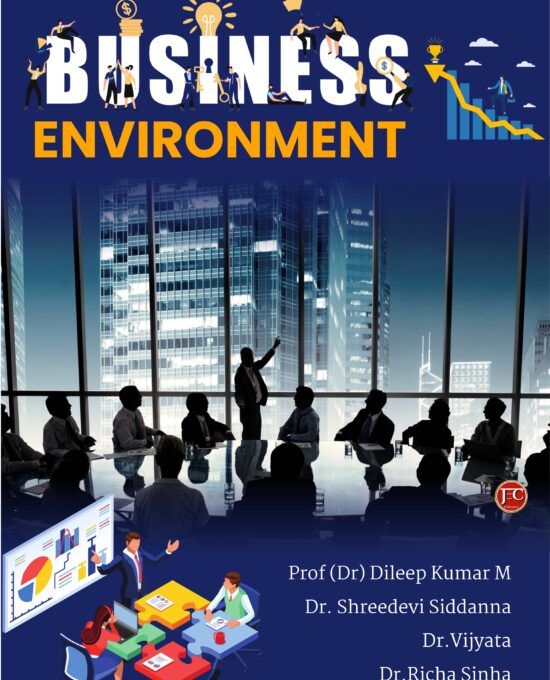
BUSINESS ENVIRONMENT
₹499.00
The contemporary business landscape is characterized by rapid transformation, global integration,
and a growing interdependence between economic, political, social, technological, and
environmental systems. In such a volatile and dynamic milieu, understanding the business
environment has become indispensable for students, managers, policymakers, and entrepreneurs
alike. The ability to interpret environmental signals, anticipate change, and respond strategically
distinguishes successful organizations from those that merely adapt to circumstances. Against this
backdrop, “Business Environment” has been conceived as a comprehensive textbook that presents
both theoretical foundations and practical insights into the multifaceted forces shaping business
decisions and performance.
This book provides a holistic view of the business ecosystem, encompassing the macro and micro
environments, the legal and regulatory framework, technological evolution, socio-cultural
dynamics, globalization, and the growing emphasis on sustainability and corporate ethics. Each
chapter is carefully designed to blend conceptual understanding with real-world applications,
supported by contemporary examples, analytical frameworks, and self-assessment exercises. The
text aligns with the syllabi prescribed for undergraduate and postgraduate management programs
across Indian universities, making it equally valuable for learners preparing for competitive and
professional examinations.
The authors have sought to present the subject matter in a lucid, structured, and pedagogically
sound manner. Each unit begins with clear learning objectives and concludes with summaries and
reflective questions to aid comprehension. The chapters are logically sequenced to ensure
continuity—from introducing the concept of business environment to exploring global challenges
and strategic responses. The inclusion of recent developments such as digital transformation,
environmental sustainability, and corporate governance ensures that the book remains relevant in
an era marked by technological disruption and responsible business practices.
What makes this book distinctive is its contextual grounding in the Indian business environment.
The text not only highlights global trends but also interprets their implications for Indian
enterprises operating within a complex and evolving policy framework. The discussion integrates
perspectives from economics, management, sociology, and public policy, thereby reflecting the
interdisciplinary nature of the subject. Our purpose has been to help learners appreciate that business decisions do not occur in isolation—they are continuously influenced by the interplay of
societal, technological, political, and ecological factors.
This work represents the culmination of our shared academic experience and collective
commitment to excellence in management education. We express our profound gratitude to our
respective institutions, colleagues, and students for their encouragement, insights, and constructive
feedback throughout the development of this book. We also acknowledge the contributions of
scholars and practitioners whose research and real-world experiences have enriched our
understanding of this dynamic field. Finally, we extend heartfelt appreciation to our families for
their unwavering support, patience, and inspiration during this intellectual journey.
It is our sincere hope that “Business Environment” will serve as a valuable learning resource and
intellectual companion for students, educators, and professionals alike. We believe that by
cultivating a deep understanding of environmental complexities and interconnections, learners will
be better equipped to lead organizations responsibly and contribute meaningfully to sustainable
economic and social progress.
- Prof. (Dr.) Dileep Kumar M
- Dr. Shreedevi Siddanna
- Dr. Vijyata
- Dr. Richa Sinha
BUSINESS ENVIRONMENT
₹499.00
The contemporary business landscape is characterized by rapid transformation, global integration,
and a growing interdependence between economic, political, social, technological, and
environmental systems. In such a volatile and dynamic milieu, understanding the business
environment has become indispensable for students, managers, policymakers, and entrepreneurs
alike. The ability to interpret environmental signals, anticipate change, and respond strategically
distinguishes successful organizations from those that merely adapt to circumstances. Against this
backdrop, “Business Environment” has been conceived as a comprehensive textbook that presents
both theoretical foundations and practical insights into the multifaceted forces shaping business
decisions and performance.
This book provides a holistic view of the business ecosystem, encompassing the macro and micro
environments, the legal and regulatory framework, technological evolution, socio-cultural
dynamics, globalization, and the growing emphasis on sustainability and corporate ethics. Each
chapter is carefully designed to blend conceptual understanding with real-world applications,
supported by contemporary examples, analytical frameworks, and self-assessment exercises. The
text aligns with the syllabi prescribed for undergraduate and postgraduate management programs
across Indian universities, making it equally valuable for learners preparing for competitive and
professional examinations.
The authors have sought to present the subject matter in a lucid, structured, and pedagogically
sound manner. Each unit begins with clear learning objectives and concludes with summaries and
reflective questions to aid comprehension. The chapters are logically sequenced to ensure
continuity—from introducing the concept of business environment to exploring global challenges
and strategic responses. The inclusion of recent developments such as digital transformation,
environmental sustainability, and corporate governance ensures that the book remains relevant in
an era marked by technological disruption and responsible business practices.
What makes this book distinctive is its contextual grounding in the Indian business environment.
The text not only highlights global trends but also interprets their implications for Indian
enterprises operating within a complex and evolving policy framework. The discussion integrates
perspectives from economics, management, sociology, and public policy, thereby reflecting the
interdisciplinary nature of the subject. Our purpose has been to help learners appreciate that business decisions do not occur in isolation—they are continuously influenced by the interplay of
societal, technological, political, and ecological factors.
This work represents the culmination of our shared academic experience and collective
commitment to excellence in management education. We express our profound gratitude to our
respective institutions, colleagues, and students for their encouragement, insights, and constructive
feedback throughout the development of this book. We also acknowledge the contributions of
scholars and practitioners whose research and real-world experiences have enriched our
understanding of this dynamic field. Finally, we extend heartfelt appreciation to our families for
their unwavering support, patience, and inspiration during this intellectual journey.
It is our sincere hope that “Business Environment” will serve as a valuable learning resource and
intellectual companion for students, educators, and professionals alike. We believe that by
cultivating a deep understanding of environmental complexities and interconnections, learners will
be better equipped to lead organizations responsibly and contribute meaningfully to sustainable
economic and social progress.
- Prof. (Dr.) Dileep Kumar M
- Dr. Shreedevi Siddanna
- Dr. Vijyata
- Dr. Richa Sinha
Clinical Physiotherapy Approaches in Spinal Muscular Atrophy
₹999.00
Spinal Muscular Atrophy (SMA) is a story that brings together genetic discovery,
neurological science, and rehabilitation innovation. For years, SMA was
considered a relentlessly progressive neuromuscular disease with few available
treatment options. Disorders that have traditionally been viewed as poor prognosis
with limited meaningful life many now intersect at the interface of genetics and
therapy, where advances in molecular genetics, early diagnosis via newborn
screening, and disease-modifying therapies are transforming both prognosis and
functional expectations.
As such, these medical innovations and advancements provide an enormous
challenge for rehabilitative professionals —especially physiotherapists —to
evolve, grow and optimize clinical practice. SMA individuals now live longer,
achieve developmental milestones once thought impossible, and enter adolescence
and adulthood with changing functional requirements. Physiotherapy wan thus
transformed from a predominantly passive and preventive health care delivery
system to an active, dynamic, and life-long treatment oriented model.
In light of this increasing gap, this book was created: a focused, evidence based
and clinically relevant resource to aid physiotherapy management in SMA. It
marries basic knowledge of genetics and pathophysiology with applied
rehabilitation science to develop approaches that encompass:
Early neurodevelopmental intervention
Functional motor training and strengthening
Respiratory physiotherapy
Orthopedic management and deformity prevention
Assistive technology and mobility solutions
Fatigue and pain management
Psychosocial and vocational transition
Clinical Physiotherapy Approaches in Spinal Muscular Atrophy
₹999.00
Spinal Muscular Atrophy (SMA) is a story that brings together genetic discovery,
neurological science, and rehabilitation innovation. For years, SMA was
considered a relentlessly progressive neuromuscular disease with few available
treatment options. Disorders that have traditionally been viewed as poor prognosis
with limited meaningful life many now intersect at the interface of genetics and
therapy, where advances in molecular genetics, early diagnosis via newborn
screening, and disease-modifying therapies are transforming both prognosis and
functional expectations.
As such, these medical innovations and advancements provide an enormous
challenge for rehabilitative professionals —especially physiotherapists —to
evolve, grow and optimize clinical practice. SMA individuals now live longer,
achieve developmental milestones once thought impossible, and enter adolescence
and adulthood with changing functional requirements. Physiotherapy wan thus
transformed from a predominantly passive and preventive health care delivery
system to an active, dynamic, and life-long treatment oriented model.
In light of this increasing gap, this book was created: a focused, evidence based
and clinically relevant resource to aid physiotherapy management in SMA. It
marries basic knowledge of genetics and pathophysiology with applied
rehabilitation science to develop approaches that encompass:
Early neurodevelopmental intervention
Functional motor training and strengthening
Respiratory physiotherapy
Orthopedic management and deformity prevention
Assistive technology and mobility solutions
Fatigue and pain management
Psychosocial and vocational transition
Computer Organization & Architecture A Handbook
₹349.00
Computer Organization and Architecture forms the foundation of computer science and
information technology education. A clear understanding of how hardware components
interact with software is essential for students pursuing careers in computing, system
design, and advanced technologies.
This book has been carefully designed with the objective of presenting core concepts in a
clear, structured, and student-friendly manner. The content emphasizes both theoretical
understanding and practical relevance, ensuring that learners develop a strong conceptual
base while appreciating real-world system behavior.
Each chapter is organized to progress logically from basic principles to advanced topics.
Concepts such as data representation, CPU organization, instruction cycles, memory
hierarchy, input/output organization, and performance evaluation are explained using
simple language, illustrative examples, and well-structured explanations. Special attention
has been given to clarity, accuracy, and alignment with examination requirements.
This book is intended primarily for undergraduate and postgraduate students of Computer
Science, Information Technology, and related disciplines, especially those enrolled in
MCA and allied programs. It will also serve as a useful reference for faculty members and
professionals seeking a concise yet comprehensive resource on Computer Organization and
Architecture.
We sincerely hope that this book will help students build confidence in the subject and
develop a strong analytical understanding of computer systems.
Mrs. Dipanjana Biswas
Mr.Subhadip Goswami
Dr. Sitanath Biswas
Ms. Pratiksha Nandi
Computer Organization & Architecture A Handbook
₹349.00
Computer Organization and Architecture forms the foundation of computer science and
information technology education. A clear understanding of how hardware components
interact with software is essential for students pursuing careers in computing, system
design, and advanced technologies.
This book has been carefully designed with the objective of presenting core concepts in a
clear, structured, and student-friendly manner. The content emphasizes both theoretical
understanding and practical relevance, ensuring that learners develop a strong conceptual
base while appreciating real-world system behavior.
Each chapter is organized to progress logically from basic principles to advanced topics.
Concepts such as data representation, CPU organization, instruction cycles, memory
hierarchy, input/output organization, and performance evaluation are explained using
simple language, illustrative examples, and well-structured explanations. Special attention
has been given to clarity, accuracy, and alignment with examination requirements.
This book is intended primarily for undergraduate and postgraduate students of Computer
Science, Information Technology, and related disciplines, especially those enrolled in
MCA and allied programs. It will also serve as a useful reference for faculty members and
professionals seeking a concise yet comprehensive resource on Computer Organization and
Architecture.
We sincerely hope that this book will help students build confidence in the subject and
develop a strong analytical understanding of computer systems.
Mrs. Dipanjana Biswas
Mr.Subhadip Goswami
Dr. Sitanath Biswas
Ms. Pratiksha Nandi