

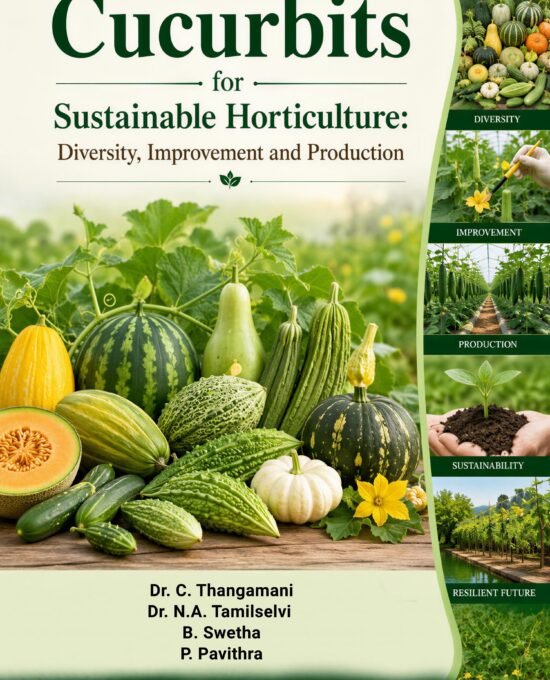
Cucurbits for Sustainable Horticulture Diversity Improvement and Production
₹499.00
Cucurbitaceous vegetables occupy a prominent position in horticulture due to their rich
diversity, wide adaptability, high productivity, nutritional importance, and economic value. The
family Cucurbitaceae comprises several commercially important crops, including gourds,
squashes and pumpkin which contribute significantly to food and nutritional security across
tropical, subtropical, and temperate regions. Besides being rich sources of vitamins, minerals,
dietary fibre, antioxidants, and other bioactive compounds, these vegetables possess several
medicinal and therapeutic properties, making them an important component of a balanced and
healthy diet.
Growing demand for high-quality vegetables, together with the challenges posed by climate
change, diminishing natural resources, emerging pests and diseases, and changing consumer
preferences, has underscored the need for sustainable production systems and improved
cultivars. Advances in plant breeding, crop improvement, integrated crop management, and seed
production have created new opportunities to enhance productivity while promoting
environmental sustainability. A sound understanding of the biology, genetic resources, breeding
strategies, production technologies, crop protection, and seed production of cucurbit crops is
therefore essential for students, researchers, extension personnel, and growers.
Cucurbits for Sustainable Horticulture: Diversity, Improvement and Production has been
prepared as a comprehensive and up-to-date reference on major cucurbit vegetables. The
chapters are systematically organised to provide complete coverage of each crop, beginning with
botanical description, taxonomy, species diversity, and genetic resources, followed by breeding
objectives, breeding methods, and improved varieties and hybrids. The book also presents
scientific recommendations on climate and soil requirements, propagation, nursery management,
nutrient management, irrigation, training and pruning, intercultural operations, harvesting, postharvest handling, and the economics of cultivation. Dedicated chapters on integrated pest and
disease management highlight environmentally sustainable approaches for maintaining crop
health, while detailed coverage of seed production technologies including isolation
requirements, pollination biology, rouging, harvesting, processing, and seed quality standards,
makes the book equally valuable for commercial seed producers and academic institutions.
The volume includes comprehensive chapters on bitter gourd, cucumber, bottle gourd,
watermelon, pointed gourd (parwal), pumpkin, summer squash (zucchini), ridge gourd, chowchow, and ivy gourd, incorporating recent scientific advances alongside practical
recommendations for cultivation and crop improvement.
This book is intended primarily for undergraduate and postgraduate students of horticulture and
agriculture, researchers, teachers, extension professionals, seed producers, and progressive
farmers. Every effort has been made to present the subject matter in a clear, systematic, and
reader-friendly manner without compromising scientific accuracy. The contents have been
compiled from standard references, recent research findings, and the authors' experience in
teaching, research, and extension
Cucurbits for Sustainable Horticulture Diversity Improvement and Production
₹499.00
Cucurbitaceous vegetables occupy a prominent position in horticulture due to their rich
diversity, wide adaptability, high productivity, nutritional importance, and economic value. The
family Cucurbitaceae comprises several commercially important crops, including gourds,
squashes and pumpkin which contribute significantly to food and nutritional security across
tropical, subtropical, and temperate regions. Besides being rich sources of vitamins, minerals,
dietary fibre, antioxidants, and other bioactive compounds, these vegetables possess several
medicinal and therapeutic properties, making them an important component of a balanced and
healthy diet.
Growing demand for high-quality vegetables, together with the challenges posed by climate
change, diminishing natural resources, emerging pests and diseases, and changing consumer
preferences, has underscored the need for sustainable production systems and improved
cultivars. Advances in plant breeding, crop improvement, integrated crop management, and seed
production have created new opportunities to enhance productivity while promoting
environmental sustainability. A sound understanding of the biology, genetic resources, breeding
strategies, production technologies, crop protection, and seed production of cucurbit crops is
therefore essential for students, researchers, extension personnel, and growers.
Cucurbits for Sustainable Horticulture: Diversity, Improvement and Production has been
prepared as a comprehensive and up-to-date reference on major cucurbit vegetables. The
chapters are systematically organised to provide complete coverage of each crop, beginning with
botanical description, taxonomy, species diversity, and genetic resources, followed by breeding
objectives, breeding methods, and improved varieties and hybrids. The book also presents
scientific recommendations on climate and soil requirements, propagation, nursery management,
nutrient management, irrigation, training and pruning, intercultural operations, harvesting, postharvest handling, and the economics of cultivation. Dedicated chapters on integrated pest and
disease management highlight environmentally sustainable approaches for maintaining crop
health, while detailed coverage of seed production technologies including isolation
requirements, pollination biology, rouging, harvesting, processing, and seed quality standards,
makes the book equally valuable for commercial seed producers and academic institutions.
The volume includes comprehensive chapters on bitter gourd, cucumber, bottle gourd,
watermelon, pointed gourd (parwal), pumpkin, summer squash (zucchini), ridge gourd, chowchow, and ivy gourd, incorporating recent scientific advances alongside practical
recommendations for cultivation and crop improvement.
This book is intended primarily for undergraduate and postgraduate students of horticulture and
agriculture, researchers, teachers, extension professionals, seed producers, and progressive
farmers. Every effort has been made to present the subject matter in a clear, systematic, and
reader-friendly manner without compromising scientific accuracy. The contents have been
compiled from standard references, recent research findings, and the authors' experience in
teaching, research, and extension

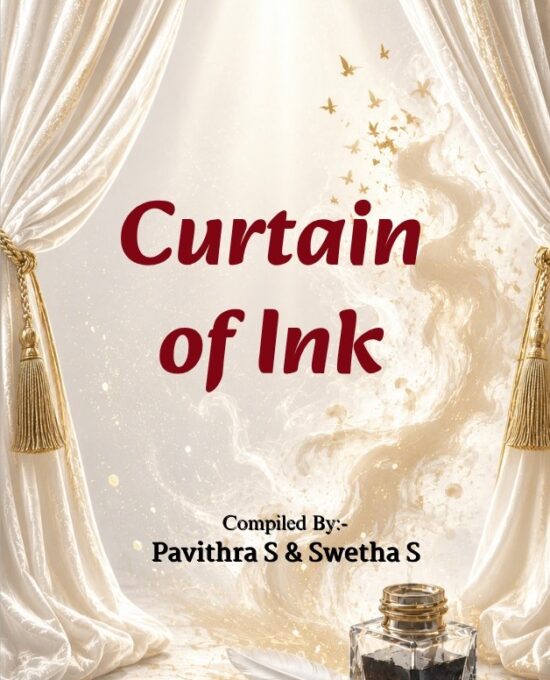
Curtain of Ink
₹349.00
Curtain of Ink is an anthology woven from the soul of theatre where every stage light hides a story, every curtain rise awakens emotions, and every line of ink breathes life into forgotten voices.
Curtain of Ink
₹349.00
Curtain of Ink is an anthology woven from the soul of theatre where every stage light hides a story, every curtain rise awakens emotions, and every line of ink breathes life into forgotten voices.