Quantitative Decision-making Statistical Modeling And Analytics
₹499.00
Business today operates in an era defined by data, where decisions are increasingly
driven by analytical insights rather than intuition alone. This book, Quantitative
Decision-Making: Statistical Modeling and Analytics, has been carefully structured
to provide students, researchers, and practitioners with both the theoretical foundation
and the practical applications of statistics in the business world. Beginning with the
fundamentals of descriptive and inferential statistics, the text progresses through
advanced topics such as regression analysis, predictive modeling, big data analytics,
and strategic decision-making. Each chapter integrates conceptual clarity with
practical illustrations, ensuring that readers not only understand statistical principles
but also learn to apply them effectively in real-world contexts.
Special emphasis has been placed on bridging statistical theory with business
applications—ranging from hypothesis testing in market research to predictive
modeling in risk assessment and customer behavior analysis. The inclusion of tools
such as Tableau, Power BI, and Python-based visualizations reflects the growing
importance of software-driven analytics in modern organizations. Furthermore, topics
on ethics, transparency, and responsible reporting encourage critical thinking about
the role of data in shaping strategies and policies.
This book aims to serve as a comprehensive guide, equipping readers with the ability
to interpret data, communicate findings, and make informed decisions that foster
sustainable business growth.
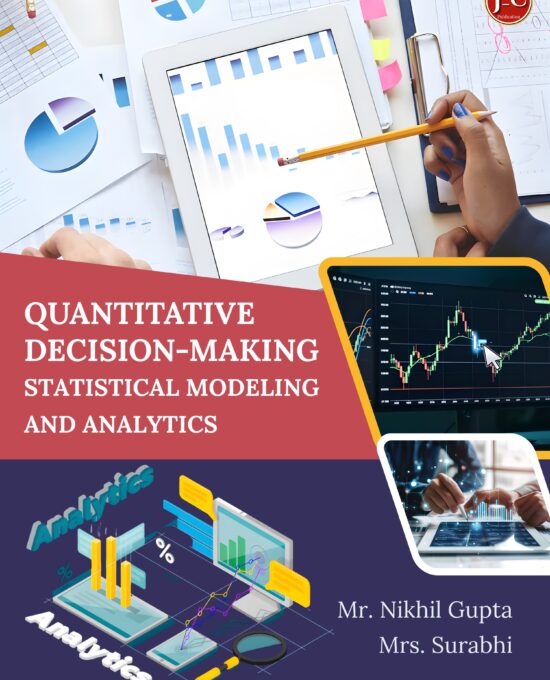
Quantitative Decision-making Statistical Modeling And Analytics
₹499.00
Business today operates in an era defined by data, where decisions are increasingly
driven by analytical insights rather than intuition alone. This book, Quantitative
Decision-Making: Statistical Modeling and Analytics, has been carefully structured
to provide students, researchers, and practitioners with both the theoretical foundation
and the practical applications of statistics in the business world. Beginning with the
fundamentals of descriptive and inferential statistics, the text progresses through
advanced topics such as regression analysis, predictive modeling, big data analytics,
and strategic decision-making. Each chapter integrates conceptual clarity with
practical illustrations, ensuring that readers not only understand statistical principles
but also learn to apply them effectively in real-world contexts.
Special emphasis has been placed on bridging statistical theory with business
applications—ranging from hypothesis testing in market research to predictive
modeling in risk assessment and customer behavior analysis. The inclusion of tools
such as Tableau, Power BI, and Python-based visualizations reflects the growing
importance of software-driven analytics in modern organizations. Furthermore, topics
on ethics, transparency, and responsible reporting encourage critical thinking about
the role of data in shaping strategies and policies.
This book aims to serve as a comprehensive guide, equipping readers with the ability
to interpret data, communicate findings, and make informed decisions that foster
sustainable business growth.


RESEARCH AND PUBLICATION ETHICS
₹499.00
In the rapidly transforming world of academia, where research serves as the foundation of innovation
and intellectual advancement, the integrity of scholarly work has never been more crucial. Research and
Publication Ethics emerges as a timely and comprehensive text designed to strengthen the moral,
professional, and intellectual framework of research practice. The purpose of this book is to nurture an
ethical research culture among scholars, academicians, and practitioners by providing a deep and
structured understanding of the principles that govern responsible research and publication.
This book systematically explores the philosophical underpinnings, ethical theories, and professional
guidelines that shape contemporary research ethics. It encompasses a wide spectrum of themes,
including academic integrity, plagiarism, authorship ethics, peer review systems, conflicts of interest,
data management, and publication ethics. In addition, it addresses emerging concerns in the digital
era—such as artificial intelligence, open science, big data analytics, biotechnology, and predatory
publishing—offering readers a holistic view of how ethical frameworks evolve in response to
technological and global academic transformations. Each unit of this book has been designed to blend
theoretical insights with practical implications, supported by case studies, reflective exercises, and
global guidelines such as COPE, ICMJE, and UGC regulations.
The authors of this volume collectively represent a distinguished blend of academic excellence,
research expertise, and professional experience. Prof. (Dr.) Dileep Kumar M, International Research
Fellow at SEGi University, Kuala Lumpur, and Vice Chancellor of Hensard University, Nigeria, brings
to this book over two decades of global academic leadership and scholarly contribution in strategic
management, entrepreneurship, and organizational behavior. Dr. Normala S. Govindarajo, Associate
Professor at HELP University, Malaysia, adds depth with her dual doctoral expertise in Management
and Human Resource, her extensive body of published work, and her interdisciplinary engagement with
technology and professional ethics. Dr. Vijyata, Assistant Professor at ARKA Jain University,
Jamshedpur, contributes her profound academic insight, rich teaching experience, and scholarly
contributions in research methodology, marketing, and digital transformation, reflecting a strong
commitment to ethical scholarship and sustainability. Mrs. Princia Stivenson Coutinho, Assistant
Professor at VIVA College of Arts, Science and Commerce, Mumbai University, lends her deep
expertise in commerce, financial accounting, and corporate governance, bridging ethical theory with
real-world application in finance and business ethics.
This collective endeavor reflects the authors’ shared vision—to cultivate awareness, accountability, and
integrity among current and future researchers. By synthesizing both classical theories and modern frameworks, the book provides a strong ethical foundation necessary for conducting credible,
transparent, and socially responsible research.
It is hoped that Research and Publication Ethics will serve as a comprehensive guide for students,
faculty members, and researchers across disciplines, fostering a scholarly ecosystem grounded in
honesty, fairness, and professional excellence. The authors express their sincere gratitude to their
respective institutions and peers whose encouragement and collaboration made this work possible.
May this book inspire every reader to uphold the sanctity of research and contribute meaningfully to the
global pursuit of knowledge rooted in ethical responsibility.
Prof. (Dr.) Dileep Kumar M
Dr. Normala S. Govindarajo,
Dr. Vijyata
Mrs. Princia Stivenson Coutinho
RESEARCH AND PUBLICATION ETHICS
₹499.00
In the rapidly transforming world of academia, where research serves as the foundation of innovation
and intellectual advancement, the integrity of scholarly work has never been more crucial. Research and
Publication Ethics emerges as a timely and comprehensive text designed to strengthen the moral,
professional, and intellectual framework of research practice. The purpose of this book is to nurture an
ethical research culture among scholars, academicians, and practitioners by providing a deep and
structured understanding of the principles that govern responsible research and publication.
This book systematically explores the philosophical underpinnings, ethical theories, and professional
guidelines that shape contemporary research ethics. It encompasses a wide spectrum of themes,
including academic integrity, plagiarism, authorship ethics, peer review systems, conflicts of interest,
data management, and publication ethics. In addition, it addresses emerging concerns in the digital
era—such as artificial intelligence, open science, big data analytics, biotechnology, and predatory
publishing—offering readers a holistic view of how ethical frameworks evolve in response to
technological and global academic transformations. Each unit of this book has been designed to blend
theoretical insights with practical implications, supported by case studies, reflective exercises, and
global guidelines such as COPE, ICMJE, and UGC regulations.
The authors of this volume collectively represent a distinguished blend of academic excellence,
research expertise, and professional experience. Prof. (Dr.) Dileep Kumar M, International Research
Fellow at SEGi University, Kuala Lumpur, and Vice Chancellor of Hensard University, Nigeria, brings
to this book over two decades of global academic leadership and scholarly contribution in strategic
management, entrepreneurship, and organizational behavior. Dr. Normala S. Govindarajo, Associate
Professor at HELP University, Malaysia, adds depth with her dual doctoral expertise in Management
and Human Resource, her extensive body of published work, and her interdisciplinary engagement with
technology and professional ethics. Dr. Vijyata, Assistant Professor at ARKA Jain University,
Jamshedpur, contributes her profound academic insight, rich teaching experience, and scholarly
contributions in research methodology, marketing, and digital transformation, reflecting a strong
commitment to ethical scholarship and sustainability. Mrs. Princia Stivenson Coutinho, Assistant
Professor at VIVA College of Arts, Science and Commerce, Mumbai University, lends her deep
expertise in commerce, financial accounting, and corporate governance, bridging ethical theory with
real-world application in finance and business ethics.
This collective endeavor reflects the authors’ shared vision—to cultivate awareness, accountability, and
integrity among current and future researchers. By synthesizing both classical theories and modern frameworks, the book provides a strong ethical foundation necessary for conducting credible,
transparent, and socially responsible research.
It is hoped that Research and Publication Ethics will serve as a comprehensive guide for students,
faculty members, and researchers across disciplines, fostering a scholarly ecosystem grounded in
honesty, fairness, and professional excellence. The authors express their sincere gratitude to their
respective institutions and peers whose encouragement and collaboration made this work possible.
May this book inspire every reader to uphold the sanctity of research and contribute meaningfully to the
global pursuit of knowledge rooted in ethical responsibility.
Prof. (Dr.) Dileep Kumar M
Dr. Normala S. Govindarajo,
Dr. Vijyata
Mrs. Princia Stivenson Coutinho
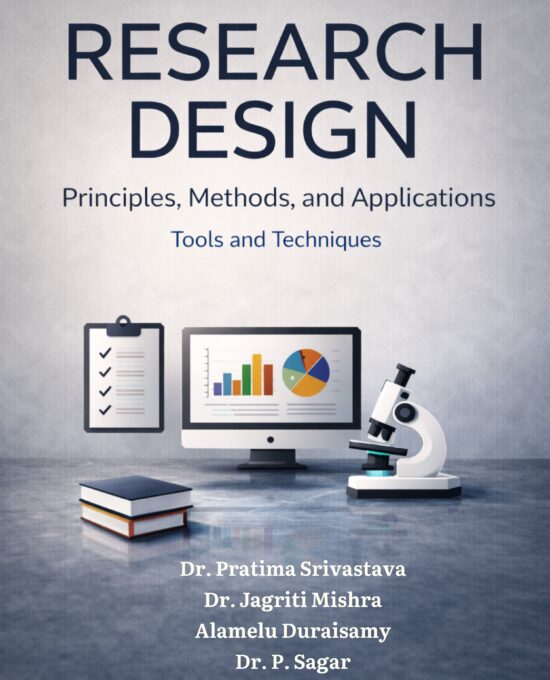
Research Design Principles, Methods, And Applications Tools And Techniques
₹499.00
Research is the cornerstone of knowledge creation, academic inquiry, and evidence-based decisionmaking. In every discipline—whether social sciences, management, education, health, or applied
sciences—the quality of research outcomes depends fundamentally on the soundness of the
research design. A well-conceived design does not merely guide data collection and analysis; it
shapes how questions are framed, how reality is interpreted, and how knowledge contributes to
theory, practice, and society. This book, Research Design: Principles, Methods, and Applications
— Tools and Techniques, has been conceived with the objective of enabling learners, scholars, and
practitioners to approach research design with conceptual clarity, methodological rigor, and
reflective understanding.
The text offers a systematic and comprehensive exploration of research design beginning with its
foundational concepts, philosophical underpinnings, and historical evolution. It highlights how
ontology, epistemology, and methodology together inform the worldview of the researcher and
influence the logic and structure of inquiry. The book further extends into diverse design
traditions—quantitative, qualitative, mixed-methods, experimental, survey, correlational,
ethnographic, phenomenological, and case study research—illustrating how each design addresses
distinct research purposes and contexts. Special emphasis has been placed on helping readers
recognize the alignment between research questions, methods, validity concerns, ethical
responsibility, and practical feasibility.
A distinguishing feature of this work is its balanced integration of theory and application. Each unit
is designed not only to explain methodological principles but also to demonstrate how they operate
in real-world research settings across disciplines. Discussions on sampling design, measurement
and scaling, data collection tools, digital research techniques, software-supported analysis,
reliability, trustworthiness, and ethics equip learners with both conceptual depth and practical skill.
The book also guides emerging researchers through proposal development, report writing,
academic publishing, and scholarly communication, thereby bridging the gap between
methodological understanding and research practice.
This book is intended for students, early-career researchers, faculty members, and professionals
who seek to design studies that are methodologically coherent, ethically grounded, and socially
relevant. It encourages reflective thinking, critical engagement, and informed methodological
choice—qualities essential for responsible and impactful research in contemporary academic and professional environments. It is our hope that the text will serve not only as a reference resource but
also as a companion in the intellectual journey of inquiry, discovery, and scholarly contribution.
—The Authors
Dr. Pratima Srivastava
Dr. Jagriti Mishra
Ms. Alamelu Duraisamy
Dr. P. Sagar
Research Design Principles, Methods, And Applications Tools And Techniques
₹499.00
Research is the cornerstone of knowledge creation, academic inquiry, and evidence-based decisionmaking. In every discipline—whether social sciences, management, education, health, or applied
sciences—the quality of research outcomes depends fundamentally on the soundness of the
research design. A well-conceived design does not merely guide data collection and analysis; it
shapes how questions are framed, how reality is interpreted, and how knowledge contributes to
theory, practice, and society. This book, Research Design: Principles, Methods, and Applications
— Tools and Techniques, has been conceived with the objective of enabling learners, scholars, and
practitioners to approach research design with conceptual clarity, methodological rigor, and
reflective understanding.
The text offers a systematic and comprehensive exploration of research design beginning with its
foundational concepts, philosophical underpinnings, and historical evolution. It highlights how
ontology, epistemology, and methodology together inform the worldview of the researcher and
influence the logic and structure of inquiry. The book further extends into diverse design
traditions—quantitative, qualitative, mixed-methods, experimental, survey, correlational,
ethnographic, phenomenological, and case study research—illustrating how each design addresses
distinct research purposes and contexts. Special emphasis has been placed on helping readers
recognize the alignment between research questions, methods, validity concerns, ethical
responsibility, and practical feasibility.
A distinguishing feature of this work is its balanced integration of theory and application. Each unit
is designed not only to explain methodological principles but also to demonstrate how they operate
in real-world research settings across disciplines. Discussions on sampling design, measurement
and scaling, data collection tools, digital research techniques, software-supported analysis,
reliability, trustworthiness, and ethics equip learners with both conceptual depth and practical skill.
The book also guides emerging researchers through proposal development, report writing,
academic publishing, and scholarly communication, thereby bridging the gap between
methodological understanding and research practice.
This book is intended for students, early-career researchers, faculty members, and professionals
who seek to design studies that are methodologically coherent, ethically grounded, and socially
relevant. It encourages reflective thinking, critical engagement, and informed methodological
choice—qualities essential for responsible and impactful research in contemporary academic and professional environments. It is our hope that the text will serve not only as a reference resource but
also as a companion in the intellectual journey of inquiry, discovery, and scholarly contribution.
—The Authors
Dr. Pratima Srivastava
Dr. Jagriti Mishra
Ms. Alamelu Duraisamy
Dr. P. Sagar

Research Methodology- Quantitative & Qualitative Approach
₹799.00
Research has always been the cornerstone of intellectual progress, academic advancement, and evidence-based decision-making. In an era characterised by rapid technological transformation, evolving societal challenges, interdisciplinary inquiry, and data-driven governance, the importance of systematic and rigorous research has become more significant than ever before. Whether in social sciences, management, law, education, technology, or public policy, research serves as a powerful tool for generating knowledge, solving problems, developing theories, and guiding meaningful action. It is within this broader academic and societal context that the present book, Research Methodology: Quantitative & Qualitative Approaches, has been conceptualised and developed.
This book is designed to provide students, scholars, academicians, and emerging researchers with a comprehensive understanding of both quantitative and qualitative research methodologies. The objective is not merely to introduce research as a technical procedure, but to cultivate a deeper appreciation of research as a disciplined intellectual process grounded in critical inquiry, systematic analysis, ethical integrity, and scholarly rigor. The book seeks to bridge the gap between theoretical understanding and practical application by presenting methodological concepts in a structured, learner-friendly, and academically enriched manner.
The text systematically covers the major dimensions of research methodology, beginning with the conceptual foundations of research and progressing through research design, problem formulation, literature review, hypothesis development, sampling techniques, instrument design, data collection methods, statistical analysis, qualitative inquiry, mixed methods research, and research ethics. Special emphasis has been placed on integrating both quantitative and qualitative traditions, thereby enabling readers to appreciate the complementary nature of diverse research paradigms and methodological approaches. The inclusion of analytical tools and software applications such as SPSS, AMOS, Power BI, NVivo, ATLAS.ti, and Jamovi further enhances the practical orientation of the book and aligns it with contemporary research practices.
One of the distinguishing strengths of this book lies in the interdisciplinary expertise of its authors, whose collective academic backgrounds bring together perspectives from law, management, research methodology, education, technology, and social sciences. This collaborative scholarly effort has enriched the text with diverse methodological insights and practical relevance across multiple disciplines.
Shivansh Chouhan, Assistant Professor of Law and Ph.D. Research Scholar at Himachal Pradesh National Law University (HPNLU), Shimla, contributes a strong interdisciplinary perspective rooted in Constitutional Law, Human Rights, Artificial Intelligence, Cybersecurity, and empirical legal research. His expertise in research methodologies and qualitative analysis tools has significantly contributed to the analytical and contemporary dimensions of this book.
Ms. Juilee Joshi brings valuable academic insight and scholarly engagement to this work through her commitment to teaching, research, and methodological learning. Her academic contributions and interest in systematic inquiry have enriched the learner-centric orientation and practical applicability of the text.
Dr. Manabhanjan Sahu, an accomplished academician and researcher with extensive experience in both industry and higher education, contributes deep expertise in management research, innovation, digital transformation, and applied academic inquiry. His rich scholarly profile, research publications, patents, and administrative experience have strengthened the methodological rigor and applied research orientation of this book.
Anjali Srivastav, educator, academic writer, and Ph.D. Research Scholar, contributes her academic interests in research methodology, scholarly studies, and critical inquiry. Her dedication to promoting systematic research practices and academic excellence has added depth to the pedagogical and conceptual framework of the text.
Throughout the book, sincere efforts have been made to contextualise methodological discussions within contemporary academic, organisational, legal, and social realities. Illustrations, examples, and conceptual discussions have been presented in a manner that enables readers to connect theoretical foundations with practical research applications. The text is intended to support postgraduate students, doctoral researchers, faculty members, and professionals who seek to develop competence in designing, conducting, analysing, and presenting high-quality research.
Research methodology is not merely a collection of techniques; it is the foundation of disciplined thinking and scientific inquiry. It teaches individuals how to ask meaningful questions, evaluate evidence critically, analyse information systematically, and contribute responsibly to knowledge creation. In today’s information-rich yet often misinformation-driven world, these abilities are essential not only for researchers but for all informed professionals and responsible citizens.
We express our heartfelt gratitude to all teachers, scholars, mentors, colleagues, students, and institutions whose intellectual guidance, encouragement, and academic interactions have contributed to the completion of this work. We also acknowledge the contributions of pioneering researchers and methodologists whose scholarly works continue to inspire generations of learners and researchers across disciplines.
While every effort has been made to ensure accuracy, clarity, and comprehensiveness, we recognise that research methodology is an evolving field, constantly shaped by new paradigms, technologies, and interdisciplinary developments. Constructive feedback and scholarly suggestions from readers will therefore always be welcomed for future refinement and improvement.
It is our sincere hope that this book will serve as a valuable academic companion for students, researchers, academicians, and professionals engaged in the pursuit of rigorous, ethical, and impactful research.
Shivansh Chouhan
Ms. Juilee Joshi
Dr. Manabhanjan Sahu
Anjali Srivastav
Research Methodology- Quantitative & Qualitative Approach
₹799.00
Research has always been the cornerstone of intellectual progress, academic advancement, and evidence-based decision-making. In an era characterised by rapid technological transformation, evolving societal challenges, interdisciplinary inquiry, and data-driven governance, the importance of systematic and rigorous research has become more significant than ever before. Whether in social sciences, management, law, education, technology, or public policy, research serves as a powerful tool for generating knowledge, solving problems, developing theories, and guiding meaningful action. It is within this broader academic and societal context that the present book, Research Methodology: Quantitative & Qualitative Approaches, has been conceptualised and developed.
This book is designed to provide students, scholars, academicians, and emerging researchers with a comprehensive understanding of both quantitative and qualitative research methodologies. The objective is not merely to introduce research as a technical procedure, but to cultivate a deeper appreciation of research as a disciplined intellectual process grounded in critical inquiry, systematic analysis, ethical integrity, and scholarly rigor. The book seeks to bridge the gap between theoretical understanding and practical application by presenting methodological concepts in a structured, learner-friendly, and academically enriched manner.
The text systematically covers the major dimensions of research methodology, beginning with the conceptual foundations of research and progressing through research design, problem formulation, literature review, hypothesis development, sampling techniques, instrument design, data collection methods, statistical analysis, qualitative inquiry, mixed methods research, and research ethics. Special emphasis has been placed on integrating both quantitative and qualitative traditions, thereby enabling readers to appreciate the complementary nature of diverse research paradigms and methodological approaches. The inclusion of analytical tools and software applications such as SPSS, AMOS, Power BI, NVivo, ATLAS.ti, and Jamovi further enhances the practical orientation of the book and aligns it with contemporary research practices.
One of the distinguishing strengths of this book lies in the interdisciplinary expertise of its authors, whose collective academic backgrounds bring together perspectives from law, management, research methodology, education, technology, and social sciences. This collaborative scholarly effort has enriched the text with diverse methodological insights and practical relevance across multiple disciplines.
Shivansh Chouhan, Assistant Professor of Law and Ph.D. Research Scholar at Himachal Pradesh National Law University (HPNLU), Shimla, contributes a strong interdisciplinary perspective rooted in Constitutional Law, Human Rights, Artificial Intelligence, Cybersecurity, and empirical legal research. His expertise in research methodologies and qualitative analysis tools has significantly contributed to the analytical and contemporary dimensions of this book.
Ms. Juilee Joshi brings valuable academic insight and scholarly engagement to this work through her commitment to teaching, research, and methodological learning. Her academic contributions and interest in systematic inquiry have enriched the learner-centric orientation and practical applicability of the text.
Dr. Manabhanjan Sahu, an accomplished academician and researcher with extensive experience in both industry and higher education, contributes deep expertise in management research, innovation, digital transformation, and applied academic inquiry. His rich scholarly profile, research publications, patents, and administrative experience have strengthened the methodological rigor and applied research orientation of this book.
Anjali Srivastav, educator, academic writer, and Ph.D. Research Scholar, contributes her academic interests in research methodology, scholarly studies, and critical inquiry. Her dedication to promoting systematic research practices and academic excellence has added depth to the pedagogical and conceptual framework of the text.
Throughout the book, sincere efforts have been made to contextualise methodological discussions within contemporary academic, organisational, legal, and social realities. Illustrations, examples, and conceptual discussions have been presented in a manner that enables readers to connect theoretical foundations with practical research applications. The text is intended to support postgraduate students, doctoral researchers, faculty members, and professionals who seek to develop competence in designing, conducting, analysing, and presenting high-quality research.
Research methodology is not merely a collection of techniques; it is the foundation of disciplined thinking and scientific inquiry. It teaches individuals how to ask meaningful questions, evaluate evidence critically, analyse information systematically, and contribute responsibly to knowledge creation. In today’s information-rich yet often misinformation-driven world, these abilities are essential not only for researchers but for all informed professionals and responsible citizens.
We express our heartfelt gratitude to all teachers, scholars, mentors, colleagues, students, and institutions whose intellectual guidance, encouragement, and academic interactions have contributed to the completion of this work. We also acknowledge the contributions of pioneering researchers and methodologists whose scholarly works continue to inspire generations of learners and researchers across disciplines.
While every effort has been made to ensure accuracy, clarity, and comprehensiveness, we recognise that research methodology is an evolving field, constantly shaped by new paradigms, technologies, and interdisciplinary developments. Constructive feedback and scholarly suggestions from readers will therefore always be welcomed for future refinement and improvement.
It is our sincere hope that this book will serve as a valuable academic companion for students, researchers, academicians, and professionals engaged in the pursuit of rigorous, ethical, and impactful research.
Shivansh Chouhan
Ms. Juilee Joshi
Dr. Manabhanjan Sahu
Anjali Srivastav

Research-Forward Anaerobic Digestion and Biogas Technology
₹499.00
The global energy landscape is undergoing a profound transformation. As the consequences of fossil fuel
dependence become increasingly apparent through climate change, resource depletion, and geopolitical
instability, the imperative to develop clean, renewable energy alternatives has never been more urgent.
Among the spectrum of renewable energy technologies available today, biogas stands out as a particularly
versatile, economically viable, and environmentally meaningful solution.
This book was conceived with a dual purpose: to serve as a rigorous academic reference for researchers,
engineers, and graduate students, and to provide actionable knowledge for practitioners and policymakers
working at the interface of energy, agriculture, waste management, and sustainable development. The
text draws upon decades of accumulated scientific literature, integrating classical theories with the most
recent advances in the field.
Biogas is not a new technology. Anaerobic digestion has been employed for over a century in wastewater
treatment, and rural biogas programmes in China and India have been in operation since the mid-twentieth
century. Yet the scientific understanding of the underlying microbial processes, the engineering
innovations in reactor design, and the expanding portfolio of feedstocks have transformed biogas into a
twenty-first century technology of considerable sophistication and commercial maturity.
The book is organized into ten chapters that collectively span the entire spectrum of biogas science and
technology. It begins with an introduction to the global energy context and the role of renewable energy,
before moving through the fundamentals of anaerobic digestion, the diversity of feedstock materials,
reactor engineering, and gas upgrading technologies. Dedicated chapters address experimental
methodologies, results and interpretation, economic analysis, and environmental impact assessment. A
comprehensive review of the global literature is incorporated to situate current knowledge within its
historical and scientific context.
The experimental methods chapter is particularly noteworthy, as it provides detailed protocols for
biochemical methane potential assays, pilot-scale digester operation, analytical measurements, and
statistical approaches to data interpretation. These methods are described with sufficient detail that
researchers should be able to replicate reported procedures in their own laboratories.
Sixty peer-reviewed references are cited throughout the text, representing key contributions from leading
journals including Bioresource Technology, Renewable and Sustainable Energy Reviews, Applied
Energy, Waste Management, and the Journal of Cleaner Production. These references collectively
provide a gateway to the broader literature for readers who wish to explore specific topics in greater
depth.
It is the sincere hope of the author that this work contributes meaningfully to the advancement of biogas
science and technology, and to the broader transition toward a sustainable, low-carbon energy future.
Research-Forward Anaerobic Digestion and Biogas Technology
₹499.00
The global energy landscape is undergoing a profound transformation. As the consequences of fossil fuel
dependence become increasingly apparent through climate change, resource depletion, and geopolitical
instability, the imperative to develop clean, renewable energy alternatives has never been more urgent.
Among the spectrum of renewable energy technologies available today, biogas stands out as a particularly
versatile, economically viable, and environmentally meaningful solution.
This book was conceived with a dual purpose: to serve as a rigorous academic reference for researchers,
engineers, and graduate students, and to provide actionable knowledge for practitioners and policymakers
working at the interface of energy, agriculture, waste management, and sustainable development. The
text draws upon decades of accumulated scientific literature, integrating classical theories with the most
recent advances in the field.
Biogas is not a new technology. Anaerobic digestion has been employed for over a century in wastewater
treatment, and rural biogas programmes in China and India have been in operation since the mid-twentieth
century. Yet the scientific understanding of the underlying microbial processes, the engineering
innovations in reactor design, and the expanding portfolio of feedstocks have transformed biogas into a
twenty-first century technology of considerable sophistication and commercial maturity.
The book is organized into ten chapters that collectively span the entire spectrum of biogas science and
technology. It begins with an introduction to the global energy context and the role of renewable energy,
before moving through the fundamentals of anaerobic digestion, the diversity of feedstock materials,
reactor engineering, and gas upgrading technologies. Dedicated chapters address experimental
methodologies, results and interpretation, economic analysis, and environmental impact assessment. A
comprehensive review of the global literature is incorporated to situate current knowledge within its
historical and scientific context.
The experimental methods chapter is particularly noteworthy, as it provides detailed protocols for
biochemical methane potential assays, pilot-scale digester operation, analytical measurements, and
statistical approaches to data interpretation. These methods are described with sufficient detail that
researchers should be able to replicate reported procedures in their own laboratories.
Sixty peer-reviewed references are cited throughout the text, representing key contributions from leading
journals including Bioresource Technology, Renewable and Sustainable Energy Reviews, Applied
Energy, Waste Management, and the Journal of Cleaner Production. These references collectively
provide a gateway to the broader literature for readers who wish to explore specific topics in greater
depth.
It is the sincere hope of the author that this work contributes meaningfully to the advancement of biogas
science and technology, and to the broader transition toward a sustainable, low-carbon energy future.

SMART PRICING STRATEGIES FOR THE INDIAN MARKET
₹499.00
Every product and every service in India—whether it is a cup of
roadside chai, a bag of rice in a kirana store, a smartphone on an ecommerce app, or a premium watch in a mall—ultimately faces one
decisive question: “What should we charge?” In that single number,
strategy meets reality.
Price is not just a tag. It is the only element of the marketing mix that
generates revenue, while the rest demand investment in product,
promotion, and distribution. It is also the fastest lever a business can
move—sometimes overnight—to respond to competition, costs, or
sudden changes in demand. That is why, in this book, we treat pricing
as both a communicator and a competitor: a “silent messenger” that
signals quality and positioning, and an “agile warrior” that helps firms
defend, attack, and adapt in real time.
India makes pricing even more challenging—and more fascinating. It
is not one market; it is a universe of markets, layered by income levels,
aspirations, geography, culture, and rapidly changing digital habits. In
the online world, the old certainty of a fixed sticker price is fading;
prices can shift by hour, by city, and sometimes by customer segment.
This new “algorithmic bazaar” demands not only marketing sense, but
also data awareness, ethical discipline, and legal clarity.
Smart Pricing Strategies for the Indian Market was written to help
students, entrepreneurs, and managers navigate this reality with
confidence. It blends foundational pricing principles with Indian
market examples, practical frameworks, and decision-making tools—so that pricing becomes a deliberate strategy rather than a guess, a
habit, or a reaction.
SMART PRICING STRATEGIES FOR THE INDIAN MARKET
₹499.00
Every product and every service in India—whether it is a cup of
roadside chai, a bag of rice in a kirana store, a smartphone on an ecommerce app, or a premium watch in a mall—ultimately faces one
decisive question: “What should we charge?” In that single number,
strategy meets reality.
Price is not just a tag. It is the only element of the marketing mix that
generates revenue, while the rest demand investment in product,
promotion, and distribution. It is also the fastest lever a business can
move—sometimes overnight—to respond to competition, costs, or
sudden changes in demand. That is why, in this book, we treat pricing
as both a communicator and a competitor: a “silent messenger” that
signals quality and positioning, and an “agile warrior” that helps firms
defend, attack, and adapt in real time.
India makes pricing even more challenging—and more fascinating. It
is not one market; it is a universe of markets, layered by income levels,
aspirations, geography, culture, and rapidly changing digital habits. In
the online world, the old certainty of a fixed sticker price is fading;
prices can shift by hour, by city, and sometimes by customer segment.
This new “algorithmic bazaar” demands not only marketing sense, but
also data awareness, ethical discipline, and legal clarity.
Smart Pricing Strategies for the Indian Market was written to help
students, entrepreneurs, and managers navigate this reality with
confidence. It blends foundational pricing principles with Indian
market examples, practical frameworks, and decision-making tools—so that pricing becomes a deliberate strategy rather than a guess, a
habit, or a reaction.