



Hospital Pharmacy Essentials: From Practice to Patient Care
'Hospital Pharmacy Essentials: From Practice to Patient Care' is an academic and clinical reference book authored by Dr. Nikita Ashok Parage, Dr. Akshaya S. Meher, Ms. Suvarna Bharat Kesekar, Dr. Rutuja Rajendra Hipparkar, Mrs. Yogita N. Kumbhar, Dr. Aishwarya Unchegaonkar, and Ms. Kajal Rajendra Patil. Published by JEC Publishers and Distributors in 2026, this textbook is specifically designed for fourth-year Doctor of Pharmacy (Pharm.D.) students.
The book bridges theoretical concepts with practical hospital applications, covering essential topics such as the structure and responsibilities of hospital pharmacies, the functioning of Pharmacy and Therapeutics (P&T) Committees, and the management of drug incompatibilities. It provides detailed procedural frameworks for manufacturing parenterals (such as large and small volume parenterals, ascorbic acid, calcium gluconate, and normal saline) and compounding various topical and oral powders. Additionally, the text includes comprehensive clinical case studies—complete with patient profiles, biochemical investigations, treatment charts, drug interactions, and pathophysiological analyses—for conditions including ovarian cancer, Wolff-Parkinson-White syndrome, hypoglycemia, obstructive jaundice, and deep vein thrombosis.

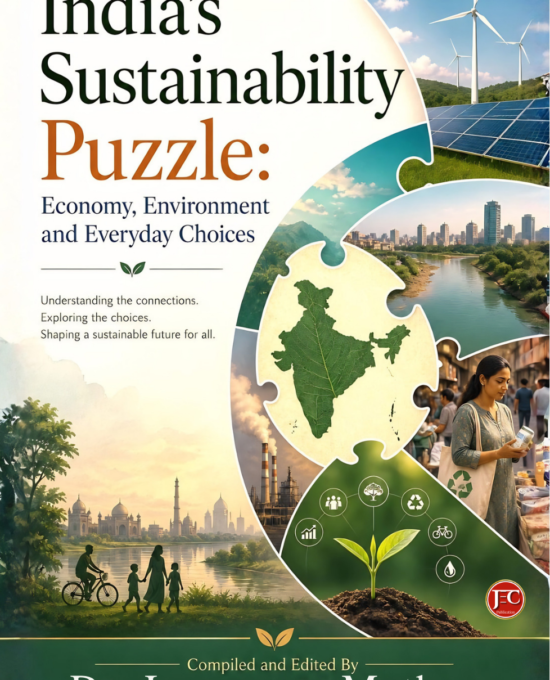
India’s Sustainability Puzzle: Economy, Environment and Everyday Choices.
India’s Sustainability Puzzle: Economy, Environment and Everyday Choices, edited by Dr. Lawrence Mathew, brings together diverse perspectives on sustainability in the Indian context. The book explores sustainability not merely as an environmental concern, but as an interconnected economic, social, institutional, technological, and behavioural challenge.
Through twelve chapters, the book examines subjects including circular economy and waste-to-infrastructure models, wetland microbiomes, sustainable agriculture and microbial approaches, menstrual health, rural entrepreneurship, gender equality and public policy, socially responsible behaviour, mangrove conservation, women's WASH challenges, and eco-tourism.
Drawing on research, case studies, policy perspectives, and practical approaches, the volume highlights how environmental protection, economic development, social inclusion, responsible consumption, and everyday choices are closely connected. It encourages readers to view sustainability as a shared responsibility and to think critically about how individual and institutional actions can contribute to a more resilient and sustainable India.

INDIAN KNOWLEDGE SYSTEMS PERSPECTIVES AND PRACTICES
INDIAN KNOWLEDGE SYSTEMS PERSPECTIVES AND PRACTICES


Industrial Pharmacy – II
