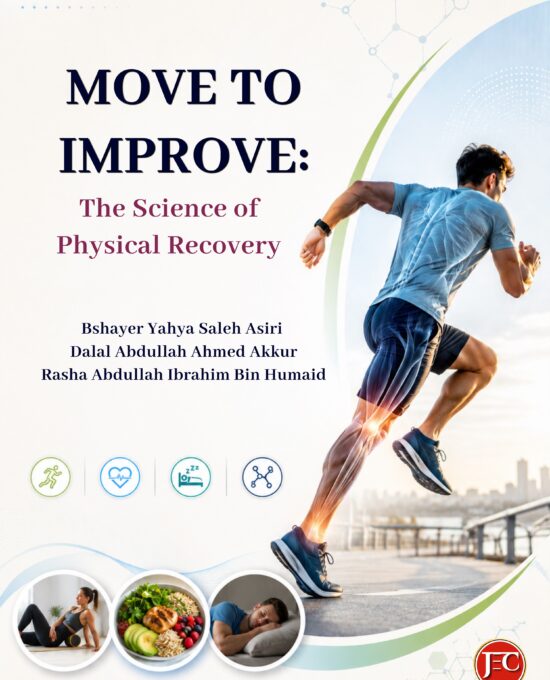
Move to Improve The Science of Physical Recovery
₹799.00
Recovery is one of the most critical, yet often misunderstood pieces to health/movement/
performance/ rehabilitation. People these days are often so enamoured with productivity,
exercise, competition and physical accomplishment that they forget to prioritise healing &
restoration for sustainable health. Real physical wellness transcends strength or fitness—it
includes your body capacity to bounce back, adjust quickly and work productively as you live.
By the time you finish Move to Improve: The Science of Physical Recovery, you'll have an
understanding of recovery through both a science and practice lens. It investigates the process
of healing after injury, adapts our bodies to stressors as well as restoring physical function and
long-term movement health. This book aims to translate modern rehabilitation science in an
accessible manner so that students, healthcare professionals, ath- letes, fitness enthusiasts and
the general readership can better understand recovery at every life stage.
Rest is only a tiny part of recovery. To float the spoiler, contemporary data reveal that healing
is not a series of techniques and processes performed with your hands; rather it happens through
such input as movement (exercise), sleep, nutrition and breathing among more variables
including mental health stress management posture evaluation lifestyle habits. Another area
where recovery has a significant correlation is the nervous system, emotions are obviously
related to suffering and stress on many levels including your environment or behaviour. The
interplay between psychosocial factors, biology and health behaviours further down the line
mediates much of what happens to people when they suffer from injury or disease –
contributing towards recovery, long-term health outcomes and rehabilitation potential;
grasping these relationships then empowers individuals as agents in driving their own health &
rehab results.
This covers a multitude of different areas in relation to physical recovery;
Biology of healing
Pain science
Exercise and rehabilitation
Stretching and mobility
Strength training
Posture and ergonomics
Move to Improve The Science of Physical Recovery
₹799.00
Recovery is one of the most critical, yet often misunderstood pieces to health/movement/
performance/ rehabilitation. People these days are often so enamoured with productivity,
exercise, competition and physical accomplishment that they forget to prioritise healing &
restoration for sustainable health. Real physical wellness transcends strength or fitness—it
includes your body capacity to bounce back, adjust quickly and work productively as you live.
By the time you finish Move to Improve: The Science of Physical Recovery, you'll have an
understanding of recovery through both a science and practice lens. It investigates the process
of healing after injury, adapts our bodies to stressors as well as restoring physical function and
long-term movement health. This book aims to translate modern rehabilitation science in an
accessible manner so that students, healthcare professionals, ath- letes, fitness enthusiasts and
the general readership can better understand recovery at every life stage.
Rest is only a tiny part of recovery. To float the spoiler, contemporary data reveal that healing
is not a series of techniques and processes performed with your hands; rather it happens through
such input as movement (exercise), sleep, nutrition and breathing among more variables
including mental health stress management posture evaluation lifestyle habits. Another area
where recovery has a significant correlation is the nervous system, emotions are obviously
related to suffering and stress on many levels including your environment or behaviour. The
interplay between psychosocial factors, biology and health behaviours further down the line
mediates much of what happens to people when they suffer from injury or disease –
contributing towards recovery, long-term health outcomes and rehabilitation potential;
grasping these relationships then empowers individuals as agents in driving their own health &
rehab results.
This covers a multitude of different areas in relation to physical recovery;
Biology of healing
Pain science
Exercise and rehabilitation
Stretching and mobility
Strength training
Posture and ergonomics
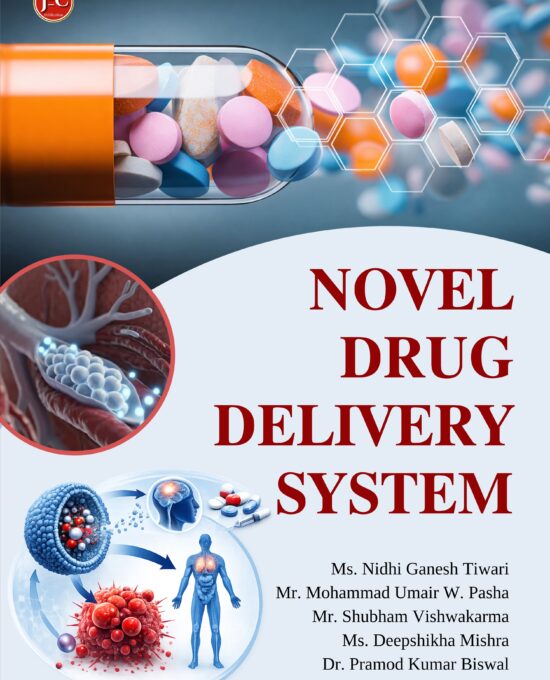
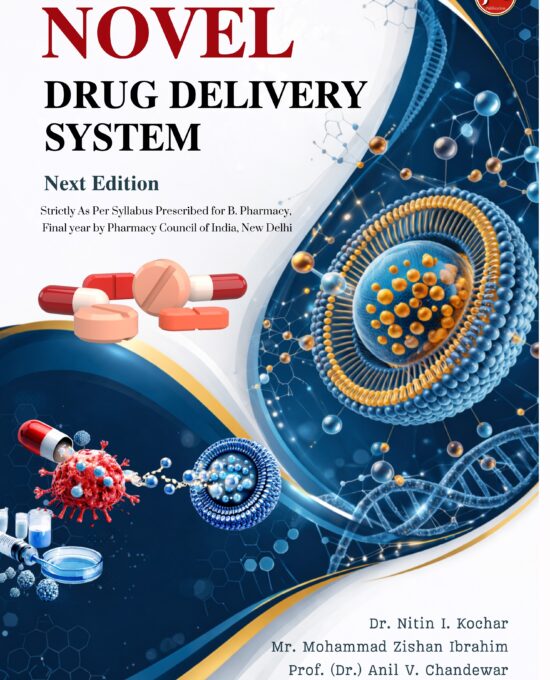
NOVEL DRUG DELIVERY SYSTEM
₹499.00
Welcome to "Novel Drug Delivery Systems," a comprehensive textbook tailored for B Pharmacy
final year students. This book is designed to provide you with a thorough understanding of the
advanced concepts and technologies in drug delivery systems that are essential for modern
pharmaceutical practice.
In recent years, significant advancements have been made in the field of drug delivery, driven by the
need for improved therapeutic efficacy, reduced side effects, and enhanced patient compliance. This
book delves into several crucial topics that form the backbone of these innovations.
The journey through this textbook begins with an exploration of Controlled Drug Delivery Systems,
where you will learn about various mechanisms to control the release rate and spatial distribution of
drugs within the body. Understanding these systems is crucial for optimizing drug therapy outcomes
and achieving targeted effects. Polymers play a pivotal role in the design and development of drug
delivery systems. A dedicated chapter discusses their properties, types, and applications in
formulating controlled and targeted drug delivery systems. This knowledge is fundamental for
manipulating drug release kinetics and ensuring stability and biocompatibility.Microencapsulation
has emerged as a powerful technique in pharmaceutical sciences, allowing for the encapsulation of
drugs within microspheres or microcapsules. This approach enhances drug stability, prolongs release,
and facilitates targeted delivery, which are thoroughly covered in this book. Implantable Drug
Delivery Systems represent another frontier in pharmaceutical technology, offering sustained release
of therapeutics over extended periods. The mechanisms, materials, and applications of these systems
are elucidated, providing insights into their clinical significance and practical implementation.
Furthermore, this book explores other contemporary topics such as Nanotechnology in Drug
Delivery, Lipid-based Delivery Systems, and Transdermal Drug Delivery, reflecting the diverse
strategies employed to overcome biological barriers and optimize therapeutic outcomes.
Each chapter is meticulously crafted to provide you with a blend of theoretical insights and practical
applications, supported by illustrative figures, case studies, and recent research findings. We aim to
equip you with the knowledge and skills necessary to critically evaluate, design, and develop novel
drug delivery systems that meet current healthcare challenges.
NOVEL DRUG DELIVERY SYSTEM
₹499.00
Welcome to "Novel Drug Delivery Systems," a comprehensive textbook tailored for B Pharmacy
final year students. This book is designed to provide you with a thorough understanding of the
advanced concepts and technologies in drug delivery systems that are essential for modern
pharmaceutical practice.
In recent years, significant advancements have been made in the field of drug delivery, driven by the
need for improved therapeutic efficacy, reduced side effects, and enhanced patient compliance. This
book delves into several crucial topics that form the backbone of these innovations.
The journey through this textbook begins with an exploration of Controlled Drug Delivery Systems,
where you will learn about various mechanisms to control the release rate and spatial distribution of
drugs within the body. Understanding these systems is crucial for optimizing drug therapy outcomes
and achieving targeted effects. Polymers play a pivotal role in the design and development of drug
delivery systems. A dedicated chapter discusses their properties, types, and applications in
formulating controlled and targeted drug delivery systems. This knowledge is fundamental for
manipulating drug release kinetics and ensuring stability and biocompatibility.Microencapsulation
has emerged as a powerful technique in pharmaceutical sciences, allowing for the encapsulation of
drugs within microspheres or microcapsules. This approach enhances drug stability, prolongs release,
and facilitates targeted delivery, which are thoroughly covered in this book. Implantable Drug
Delivery Systems represent another frontier in pharmaceutical technology, offering sustained release
of therapeutics over extended periods. The mechanisms, materials, and applications of these systems
are elucidated, providing insights into their clinical significance and practical implementation.
Furthermore, this book explores other contemporary topics such as Nanotechnology in Drug
Delivery, Lipid-based Delivery Systems, and Transdermal Drug Delivery, reflecting the diverse
strategies employed to overcome biological barriers and optimize therapeutic outcomes.
Each chapter is meticulously crafted to provide you with a blend of theoretical insights and practical
applications, supported by illustrative figures, case studies, and recent research findings. We aim to
equip you with the knowledge and skills necessary to critically evaluate, design, and develop novel
drug delivery systems that meet current healthcare challenges.
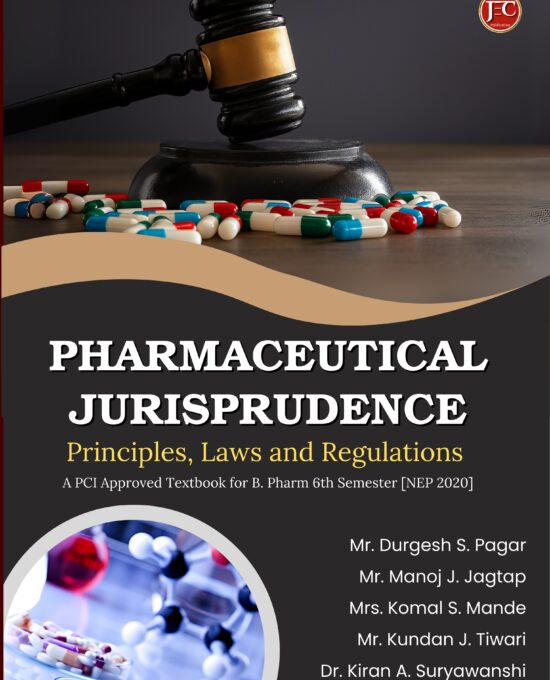
PHARMACEUTICAL JURISPRUDENCE Principles, Laws and Regulations
₹499.00
Pharmacy students can better understand the rules that affect their profession and the larger
pharmaceutical business in India by studying pharmaceutical jurisprudence, which is the basic study
of the legal and regulatory frameworks governing pharmacy. With its clear, student-friendly
presentation of key statutory instruments like the Drugs and Cosmetics Act, the Pharmacy Act,
numerous pertinent regulations, and supplemental legislations like the IPR provisions.
This book is especially made to fit the updated syllabus of B. Pharmacy according to (NEP 2020) for
Semester VI which is established by the Pharmacy Council of India. The material is clearly structured
to support self-study and improve conceptual clarity through the use of images, tables, and chapterend questions, and it is divided into five units and thirty sections.
Each section's goal is communicated clearly to help readers grasp the learning objectives and make
sure they comprehend the legislative and practical ramifications of pharmaceutical law. The writers
sincerely thank the publishing team and their academic institutions for their steadfast support. Faculty,
librarians, and co-workers who provided resources and support during the book's preparation are
especially acknowledged. Readers, whether professionals, instructors, or students, are encouraged to
provide constructive criticism so that subsequent versions can be improved.
This book explains fundamental legal concepts in pharmaceutical practice, giving pharmacy
professionals and students the necessary legal knowledge to navigate regulatory compliance, protect
patient safety, and steer clear of legal pitfalls by presenting ethics and legislation in an understandable
and straightforward manner.
PHARMACEUTICAL JURISPRUDENCE Principles, Laws and Regulations
₹499.00
Pharmacy students can better understand the rules that affect their profession and the larger
pharmaceutical business in India by studying pharmaceutical jurisprudence, which is the basic study
of the legal and regulatory frameworks governing pharmacy. With its clear, student-friendly
presentation of key statutory instruments like the Drugs and Cosmetics Act, the Pharmacy Act,
numerous pertinent regulations, and supplemental legislations like the IPR provisions.
This book is especially made to fit the updated syllabus of B. Pharmacy according to (NEP 2020) for
Semester VI which is established by the Pharmacy Council of India. The material is clearly structured
to support self-study and improve conceptual clarity through the use of images, tables, and chapterend questions, and it is divided into five units and thirty sections.
Each section's goal is communicated clearly to help readers grasp the learning objectives and make
sure they comprehend the legislative and practical ramifications of pharmaceutical law. The writers
sincerely thank the publishing team and their academic institutions for their steadfast support. Faculty,
librarians, and co-workers who provided resources and support during the book's preparation are
especially acknowledged. Readers, whether professionals, instructors, or students, are encouraged to
provide constructive criticism so that subsequent versions can be improved.
This book explains fundamental legal concepts in pharmaceutical practice, giving pharmacy
professionals and students the necessary legal knowledge to navigate regulatory compliance, protect
patient safety, and steer clear of legal pitfalls by presenting ethics and legislation in an understandable
and straightforward manner.

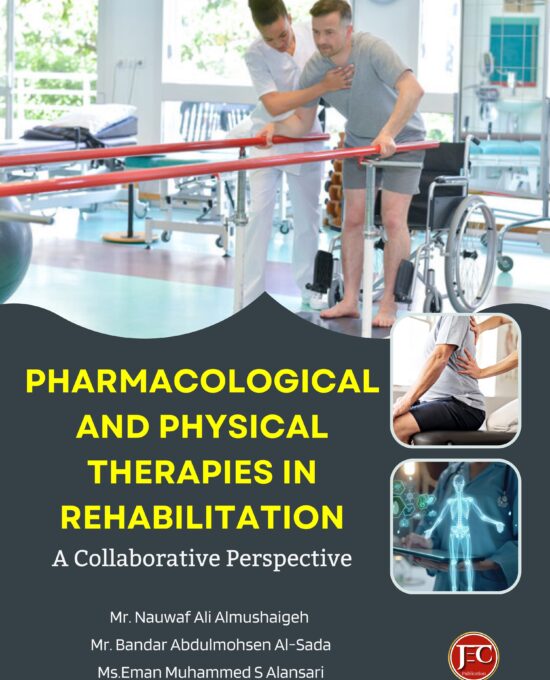
Pharmacological and Physical Therapies in Rehabilitation: A Collaborative Perspective
₹799.00
Over the past few decades, rehabilitation science has undergone a profound
transformation: from a largely siloed discipline concerned mainly with
restoring physical capability to an integrated, multidisciplinary field
characterized by evidence-based practice, patient-centered care, and
collaborative decision-making. Rehabilitation professionals today work in
ever more complex clinical environment where pharmacologic agents,
physical activity and exercise, and technology converge to promote
function, to decrease disability and to improve the quality of life.
Pharmacological and Physical Therapies in Rehabilitation: A Collaborative
Perspective was written to address the gap in knowledge that exists
between the disciplines of pharmacology and physical rehabilitation
practice. Though, each domain has their own depth in standards and
sophistication, the ideal patient outcome occurs with the context that
clinicians have an understanding of how the therapeutic strategies actually
complement—and usually influence—each other. The reasons are multiple
but organized strategy is required in the management of pain, spasticity,
inflammation, neuromuscular disorders, cardiopulmonary dysfunction,
orthopedic and chronic disease affecting mobility and functional status.
We want to provide a full resource to health professionals, students and
researchers, which encompasses:
Core pharmacological practices applicable to rehabilitation
This article reviews common drugs in use including their mechanism,
indication and adverse effects Physical therapy modalities like exercise therapy, electrotherapy, manual
therapy, therapeutic technologies, functional training
Integrated models of interprofessional collaboration that provide seamless
patient care.
Examples from various theatres of practice demonstrating practical
applications
At every stage in this book, readers will see evidence-based practice,
interprofessional collaboration, and moral obligation to provide safe and
effective care. Written at the appropriate level of clarity, with clinical
relevance and scientific rigor each chapter is designed to benefit students
beginning their journey, practicing clinicians fine tuning their skills, and
researchers pursuing creative new rehabilitation pathways.
With ongoing innovations in pharmacology, artificial intelligence,
regenerative medicine, and individualized rehabilitation, the demand for
integrated treatment strategies will continue to increase. Perhaps not just an
academic reference but also a prompt, we hope the text can stimulate some
collaborative thinking, and innovative practice.
We also thank the clinicians, educators, and other experts who have
contributed to this work and offer our heartfelt gratitude. This book has
been made possible by their dedication to the improvement of
rehabilitation science. Finally, we thank patients who, through their
resilience and trust, and willingness to teach us, have enabled our respective
journeys of learning and reflection, so that we might continue to improve
the science and practice of anesthesia. We hope that this book will aid in
the education of clinicians to be competent but also collaborative,
comprehensive, and perspective-based in their approach to rehabilitation.
Pharmacological and Physical Therapies in Rehabilitation: A Collaborative Perspective
₹799.00
Over the past few decades, rehabilitation science has undergone a profound
transformation: from a largely siloed discipline concerned mainly with
restoring physical capability to an integrated, multidisciplinary field
characterized by evidence-based practice, patient-centered care, and
collaborative decision-making. Rehabilitation professionals today work in
ever more complex clinical environment where pharmacologic agents,
physical activity and exercise, and technology converge to promote
function, to decrease disability and to improve the quality of life.
Pharmacological and Physical Therapies in Rehabilitation: A Collaborative
Perspective was written to address the gap in knowledge that exists
between the disciplines of pharmacology and physical rehabilitation
practice. Though, each domain has their own depth in standards and
sophistication, the ideal patient outcome occurs with the context that
clinicians have an understanding of how the therapeutic strategies actually
complement—and usually influence—each other. The reasons are multiple
but organized strategy is required in the management of pain, spasticity,
inflammation, neuromuscular disorders, cardiopulmonary dysfunction,
orthopedic and chronic disease affecting mobility and functional status.
We want to provide a full resource to health professionals, students and
researchers, which encompasses:
Core pharmacological practices applicable to rehabilitation
This article reviews common drugs in use including their mechanism,
indication and adverse effects Physical therapy modalities like exercise therapy, electrotherapy, manual
therapy, therapeutic technologies, functional training
Integrated models of interprofessional collaboration that provide seamless
patient care.
Examples from various theatres of practice demonstrating practical
applications
At every stage in this book, readers will see evidence-based practice,
interprofessional collaboration, and moral obligation to provide safe and
effective care. Written at the appropriate level of clarity, with clinical
relevance and scientific rigor each chapter is designed to benefit students
beginning their journey, practicing clinicians fine tuning their skills, and
researchers pursuing creative new rehabilitation pathways.
With ongoing innovations in pharmacology, artificial intelligence,
regenerative medicine, and individualized rehabilitation, the demand for
integrated treatment strategies will continue to increase. Perhaps not just an
academic reference but also a prompt, we hope the text can stimulate some
collaborative thinking, and innovative practice.
We also thank the clinicians, educators, and other experts who have
contributed to this work and offer our heartfelt gratitude. This book has
been made possible by their dedication to the improvement of
rehabilitation science. Finally, we thank patients who, through their
resilience and trust, and willingness to teach us, have enabled our respective
journeys of learning and reflection, so that we might continue to improve
the science and practice of anesthesia. We hope that this book will aid in
the education of clinicians to be competent but also collaborative,
comprehensive, and perspective-based in their approach to rehabilitation.

Pharmacy Practice in the Digital Era: Innovations, Challenges, and Future Trends
₹799.00
The practice of pharmacy is undergoing a profound transformation driven by
rapid advancements in digital technology and evolving healthcare needs.
Innovations such as electronic health records, telepharmacy, artificial
intelligence, big data analytics, automation, blockchain, and digital
therapeutics are reshaping how medicines are developed, dispensed,
monitored, and optimized for patient care. In this context, “Pharmacy Practice
in the Digital Era: Innovations, Challenges, and Future Trends” aims to
provide a comprehensive and structured understanding of the changing
landscape of pharmacy practice in a technology-enabled healthcare ecosystem.
This book has been designed to bridge the gap between traditional pharmacy
roles and emerging digital competencies required of modern pharmacists. It
explores key technological innovations influencing pharmacy practice,
examines regulatory, ethical, and operational challenges associated with digital
transformation, and highlights the expanding role of pharmacists in clinical
decision-making, data-driven care, and interdisciplinary collaboration. Special
emphasis is placed on patient safety, data security, regulatory compliance, and
equitable access to digital pharmacy services.
The content of this book is intended for a wide audience, including
undergraduate and postgraduate pharmacy students, practicing pharmacists,
educators, researchers, and healthcare professionals seeking to adapt to the
demands of digital health. By integrating theoretical concepts with practical
insights, case-based discussions, and future-oriented perspectives, the book
serves as both an academic reference and a practical guide for real-world
application.
Pharmacy Practice in the Digital Era: Innovations, Challenges, and Future Trends
₹799.00
The practice of pharmacy is undergoing a profound transformation driven by
rapid advancements in digital technology and evolving healthcare needs.
Innovations such as electronic health records, telepharmacy, artificial
intelligence, big data analytics, automation, blockchain, and digital
therapeutics are reshaping how medicines are developed, dispensed,
monitored, and optimized for patient care. In this context, “Pharmacy Practice
in the Digital Era: Innovations, Challenges, and Future Trends” aims to
provide a comprehensive and structured understanding of the changing
landscape of pharmacy practice in a technology-enabled healthcare ecosystem.
This book has been designed to bridge the gap between traditional pharmacy
roles and emerging digital competencies required of modern pharmacists. It
explores key technological innovations influencing pharmacy practice,
examines regulatory, ethical, and operational challenges associated with digital
transformation, and highlights the expanding role of pharmacists in clinical
decision-making, data-driven care, and interdisciplinary collaboration. Special
emphasis is placed on patient safety, data security, regulatory compliance, and
equitable access to digital pharmacy services.
The content of this book is intended for a wide audience, including
undergraduate and postgraduate pharmacy students, practicing pharmacists,
educators, researchers, and healthcare professionals seeking to adapt to the
demands of digital health. By integrating theoretical concepts with practical
insights, case-based discussions, and future-oriented perspectives, the book
serves as both an academic reference and a practical guide for real-world
application.